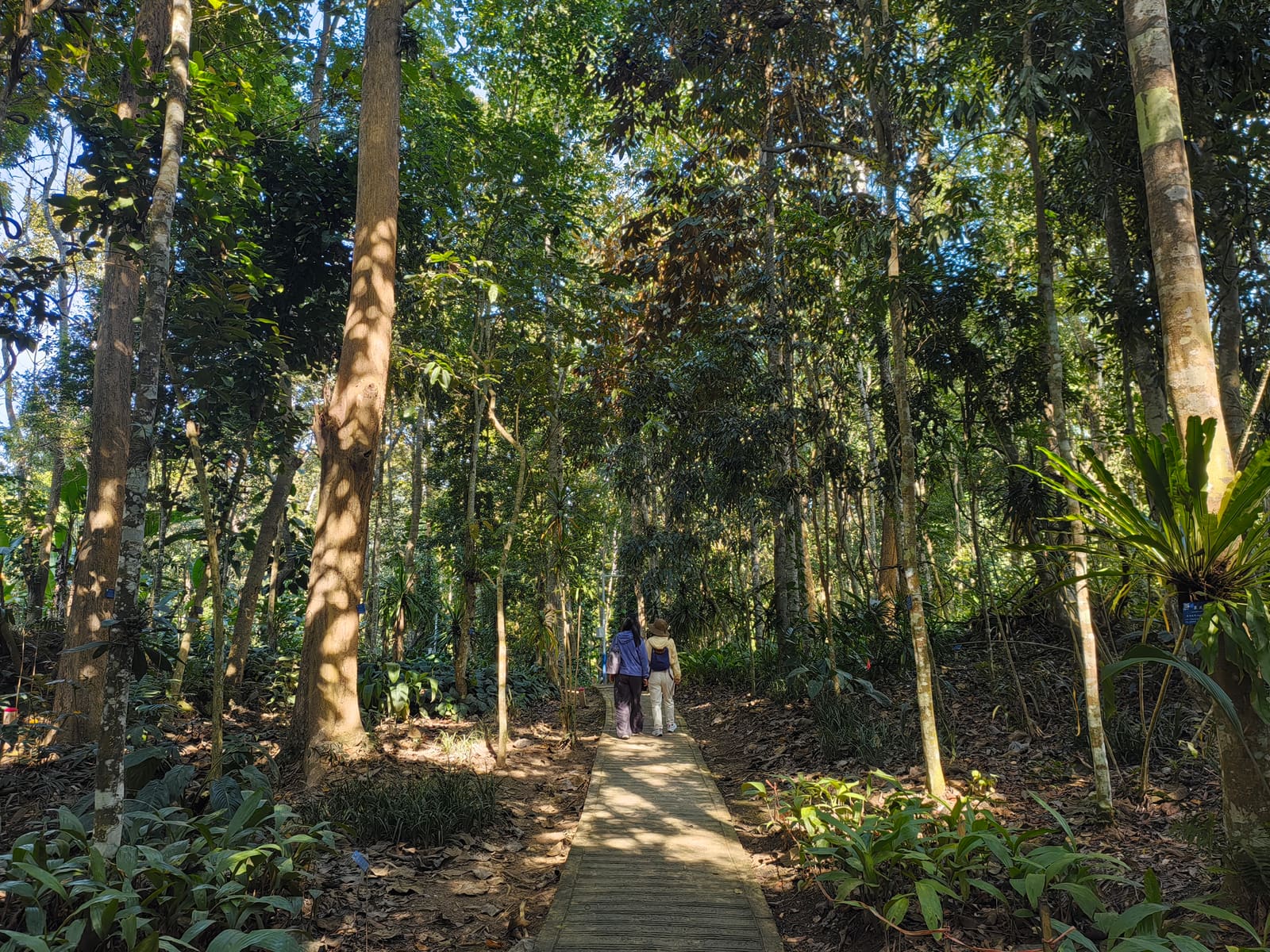
Xishuangbanna works best as a set of day trips from Jinghong, not as a two-day sweep through every rainforest and night market. The main sights point in different directions: the tropical botanical garden lies towards Mengla, Wild Elephant Valley towards Mengyang, and the tea country towards Menghai. Choose whether tropical ecology, Dai culture or Pu'er tea matters most, then allow only one long excursion each day. That single decision prevents most rushed itineraries.
When to go and how long to stay
Relatively dry weather usually makes the paths at Xishuangbanna Tropical Botanical Garden and the roads into Menghai easier to use. During the wetter months, a short downpour can interrupt a boardwalk, mountain road or water-based activity even when the morning began clear. Build a wet-weather alternative around Jinghong and accept a closure rather than looking for an unofficial way around it.
Heat, humidity and strong sun are year-round considerations in Xishuangbanna. Carry drinking water, sun protection and insect repellent; in the rainy season, add quick-drying clothes, shoes with dependable grip and a waterproof pouch for documents. A disposable poncho alone is poor protection for a long outdoor day.
Three days cover Jinghong and two outlying priorities. Four or five days leave space for Menghai, a village visit or a recovery day between road journeys. Anyone travelling with small children, older relatives or a passenger prone to motion sickness should alternate an excursion with an easier day in Jinghong.
Demand rises around the Water-Splashing Festival, school breaks and national holidays. Secure transport and accommodation with workable cancellation terms before paying for an evening show, costume photography or another optional add-on.
Arriving and getting around
Flights arrive at Xishuangbanna Gasa International Airport, while rail passengers should use the station printed on their ticket rather than assuming every service has the same terminus. The airport and railway station have different approaches to central Jinghong and Gaozhuang Xishuangjing. For a late arrival, identify the official taxi queue, the designated ride-hailing point or a documented hotel transfer before leaving the terminal.
Within Jinghong, group Manting Park and the General Buddhist Temple into one outing and treat Gaozhuang Xishuangjing as a separate evening stop. Midday heat can turn an apparently short walk into an exhausting transfer, so a brief licensed taxi ride may protect the rest of the day's schedule.
The routes to Xishuangbanna Tropical Botanical Garden, Wild Elephant Valley, Dai Park and Menghai do not form a convenient loop. Before booking a tourist shuttle or licensed private car, record the exact pickup point, return departure, waiting arrangement, parking charges and cancellation terms. A rental-car day towards Menghai also needs a road and weather check; after heavy rain or near dusk, an unfamiliar tea-mountain lane is a reason to turn back, not to follow a stranger onto a non-public road.
Choosing the main sights
Xishuangbanna Tropical Botanical Garden
The Chinese Academy of Sciences garden is the strongest choice for tropical botany, rainforest ecology and family learning. In broad terms, the western side concentrates themed plant collections, while the eastern side involves Green Stone Forest and valley-rainforest terrain. The two areas require different amounts of walking and internal transport, so reserve at least half a day and start early if both matter.
On arrival at Xishuangbanna Tropical Botanical Garden, check which areas, sightseeing vehicles and activities are operating that day. If heat, rain or a tired child reduces the available time, keep the western collections and drop the longer eastern route rather than rushing both.
Wild Elephant Valley
The purpose of Wild Elephant Valley is Asian-elephant conservation and rainforest interpretation, not a guaranteed wild sighting. Elephant movement is unpredictable, and an empty viewing period is not a failed visit. Stay on the boardwalk and marked route; never feed, call to or chase an elephant, and never step into closed forest for a photograph.
Cableway access, trails and educational programmes at Wild Elephant Valley may change with weather or maintenance. If staff close a section or report nearby wildlife activity, follow their route immediately instead of waiting in the restricted area.
Manting Park and the General Buddhist Temple
Manting Park and the General Buddhist Temple fit naturally into the same day, but they are not interchangeable attractions. The park introduces Dai history and garden culture; the temple is an active Southern Buddhist space where clothing, voice level and photography require restraint. Ask before photographing worshippers, monks, ceremonies or interiors, and follow posted routes even when another visitor ignores them.
Daytime admission to Manting Park and an evening performance may be separate products. Check the entrance, included programme, seat, admission time and refund policy before paying, especially if an afternoon storm could affect the evening.
Dai Park and village visits
Dai Park offers a concentrated introduction to village architecture, daily life and staged festival activities. During water splashing, seal phones, cameras and identity documents in a reliable waterproof pouch, and keep children away from vehicle lanes and slick steps.
For costume photography at Dai Park or Gaozhuang Xishuangjing, put the session length, clothing and makeup charges, number of original and edited files, delivery method and cancellation rule in writing. A Dai village remains a residential community: an occupied courtyard, doorway or family ceremony is not a free set, and a refusal to be photographed ends the request.
Menghai tea country
Choose Menghai or Nannuo Mountain only if the production and culture of Pu'er tea justify a full road day. A complimentary tasting at a tea business does not create an obligation to buy. Before purchasing, ask the seller to identify origin, raw material, vintage or batch, storage and business operator, then obtain an itemised receipt.
Claims that an expensive aged tea will appreciate in value or treat a health condition are reasons to stop the transaction. If the sales conversation in Menghai becomes pressurised, leave without negotiating a face-saving purchase and return with your driver by the agreed route.
Practical itineraries
Three days for a first visit
On day one, visit Manting Park and the General Buddhist Temple, rest during the hottest part of the afternoon, and go to Gaozhuang Xishuangjing in the early evening. Give day two to Xishuangbanna Tropical Botanical Garden. On day three, choose Wild Elephant Valley for conservation interpretation or Dai Park for a more concentrated cultural visit; doing both weakens each and removes the weather margin.
Five days for rainforest and tea
Use the first day to settle into Jinghong. Visit Xishuangbanna Tropical Botanical Garden on day two and Wild Elephant Valley on day three, then reserve day four for Menghai or one tea-growing area. Return to Jinghong on day five for a market, an open museum-style venue or a relaxed departure. Do not attach a long night drive to the Menghai day.
A lighter family version
For a lower-effort trip, use the western collections at Xishuangbanna Tropical Botanical Garden, the level portions of Manting Park, the interpretation at Wild Elephant Valley and a short early-evening market visit. Put lunch, toilets, water and a midday rest into the schedule. If a child is frightened by an elephant, insect or water-splashing activity, leave that interaction and continue with a quieter part of the site.
Where to stay
Gaozhuang Xishuangjing is convenient for restaurants and night-market visits, but late noise, street-facing rooms, building work and parking can outweigh that convenience. Read recent room-specific comments and ask about the actual side of the building before booking.
Central Jinghong gives easier access to everyday services and often suits early excursion departures or travellers who value sleep over nightlife. Measure the route from the hotel to the stated shuttle pickup point; a listing's distance from Gaozhuang says little about a pre-dawn collection.
Menghai or the botanical-garden area can remove a same-day return, although evening dining and onward transport are thinner. Confirm reception hours, breakfast, luggage storage and the next vehicle before moving out of Jinghong.
A pool, children's facility or airport transfer is a variable hotel service, not an automatic inclusion. During the wet season, recent evidence of dampness, mould or poor insect control should outweigh polished photographs; if a room is unsuitable on arrival, document it through the booking platform before accepting an off-platform replacement.
Food and night-market spending
Useful introductions include pineapple rice, leaf-wrapped bao shao dishes, Dai-style grilled fish, rice noodles, pounded salads, tropical fruit and Pu'er tea. At a market in Gaozhuang Xishuangjing, small portions from a few stalls are easier on the stomach than one uncontrolled mixed meal. Check that meat and seafood are cooked through, and be cautious with cold salads, ice and pre-cut fruit when storage or handling looks poor.
Before ordering in Jinghong, ask about portion size, chilli, principal ingredients and price. A traveller allergic to peanuts, tree nuts, seafood or a particular spice should name the ingredient and ask about shared utensils rather than relying on “not spicy” as an allergy check.
For fruit shipping, tea, silverware or another souvenir, record weight, packaging, courier terms, after-sales contact and responsibility for damage. If a Gaozhuang seller will not state the total or wants payment to an unrelated personal account, do not complete the purchase.
Booking checks
Operating areas, internal shuttles, performances, night visits, rafting and study programmes can all change. Check the current notice from the relevant attraction, the terms on a reputable booking platform and the announcement at the entrance; an old screenshot or short-video itinerary is not evidence that an activity is running.
A private-car order for Mengla, Mengyang or Menghai should list the vehicle, passengers, luggage, route, waiting time, requested child seat, parking and toll treatment, plus the outcome if weather closes the destination. A photography contract for Gaozhuang or Dai Park should cover original files, edited images, extra-image charges, clothing hygiene, delivery and refunds.
Mohan, Daluo and other border directions require a separate check of current identity-document, access, photography and port rules. Decline any offer of an “inside route” around a checkpoint or closed area; losing access, documents or personal safety is not a reasonable shortcut.
Safety and cultural boundaries
In rainforest settings, remain on the open route and avoid touching unfamiliar plants, insects or wildlife. A thunderstorm, falling branches, pooled water or a closure at Xishuangbanna Tropical Botanical Garden is an immediate signal to shorten the walk. At Wild Elephant Valley, legality and animal welfare take priority over a close-contact photograph.
At the General Buddhist Temple, in Dai villages and during community festivals, permission is required before photographing people or ceremonies. Drone use in Xishuangbanna must satisfy aviation, attraction, border and privacy controls at the same time; uncertainty means keeping the aircraft packed.
During water activities at Dai Park, protect identity documents and keep children away from slippery edges. In crowded areas around Gaozhuang Xishuangjing, watch bags and phones, and leave any tea, jewellery or photography sale that becomes coercive. Rain, illness, a closed road or an uncomfortable cultural interaction is a valid reason to abandon a prepaid add-on and return to Jinghong.