Attraction access, cableway and cruise services, metro operation, weather warnings and roads beyond central Chongqing can all change. Use official or clearly authorised sources for the day of travel. Night views, fog and river conditions depend on the weather; no hotel or tour operator can promise a particular panorama.
Yuzhong, Nan'an and Shapingba can be linked by metro and short walks. Dazu, Wulong, Fengjie and Wushan cannot: each needs a separate road or rail plan and, except for a focused Dazu day, often local accommodation. Build the central city by district, then add one outer direction.
Decide How Many Nights and Districts Will Fit
- Two nights for a first city visit: give one day to the Yuzhong Peninsula. On the other, choose either Shapingba's Shaci area or the river views of Nan'an instead of chasing every evening viewpoint.
- Four nights for culture or landscape: use two days in the city and add either a full day for Dazu Rock Carvings or one night in Wulong. Dazu and Wulong do not make a workable combined day trip.
- Six nights or more: spend two or three days in the core city, then choose one among Dazu, Wulong and a Fengjie–Wushan route. The Three Gorges direction needs additional transfers and nights; it is not a half-day city excursion.
- With children, older travellers or substantial luggage: stay close to a metro station and cross no more than one broad area each day. A short straight line on a map can conceal a steep stairway, a hill and entrances on different levels.
Season, Weather and Stamina
Chongqing's summer heat and humidity make Yuzhong and Nanshan climbs much harder in the afternoon. Use those hours for a museum, lunch and rest, and carry drinking water rather than relying on sweet drinks. Spring and autumn suit walking, though rain slicks stone steps and mist can erase the skyline. In winter, damp air and river wind feel colder than the temperature suggests.
Under heat, heavy-rain or thunderstorm warnings, replace river steps, Nanshan climbs and outer-district gorge routes with indoor city stops. Recheck the remote road and site before departure, and move a night view rather than risk a late return.
Yuzhong Peninsula in Short Walking Sections
Jiefangbei anchors food and metro access for Yuzhong, but Hongyadong, Chaotianmen, Huguang Guild Hall, Shibati and the Mountain City trails should be split into shorter walks. View Hongyadong's exterior from a public walkway or across the river rather than assuming its commercial interior leads to the best angle. Pair Chaotianmen with Huguang Guild Hall for a half-day, subject to the entrances and construction diversions in use.
Shibati and the Mountain City routes both involve slopes and stairs, so visitors with limited stamina can choose one. Wear footwear with grip and avoid unguarded shortcuts after rain. Liziba's train-through-building view is best treated as a brief stop while moving to another district. Use the public viewing platform and keep away from the carriageway and residential entrances.
Nan'an and Shapingba's Shaci Area
Nanbin Road, Danzishi and Nanshan are separate late-day stops, not one continuous promenade. Settle the descent from Nanshan before going up, without relying solely on instant ride-hailing on a holiday. If fog hides the skyline, remain in Nan'an for streets and dinner instead of queuing uphill.
In Shapingba, Ciqikou mixes traditional lanes with an intensely commercial visitor area. Busy hours call for close care of phones and bags and restaurants that display their prices. Geleshan and the Red Rock memorial venues have a different and serious historical purpose. Follow their reservation, security and photography rules, and allow the interpretation to stand on its own instead of presenting these places as macabre entertainment.
Plan Dazu, Wulong and the Three Gorges Separately
Dazu Rock Carvings are far enough from central Chongqing to deserve a full day or local overnight. Different carving sites may have different visitor access, transfers and interpretation, so identify exactly which one the ticket and vehicle serve. The sculptures are protected heritage: do not touch or climb them, and do not use lighting that the site prohibits.
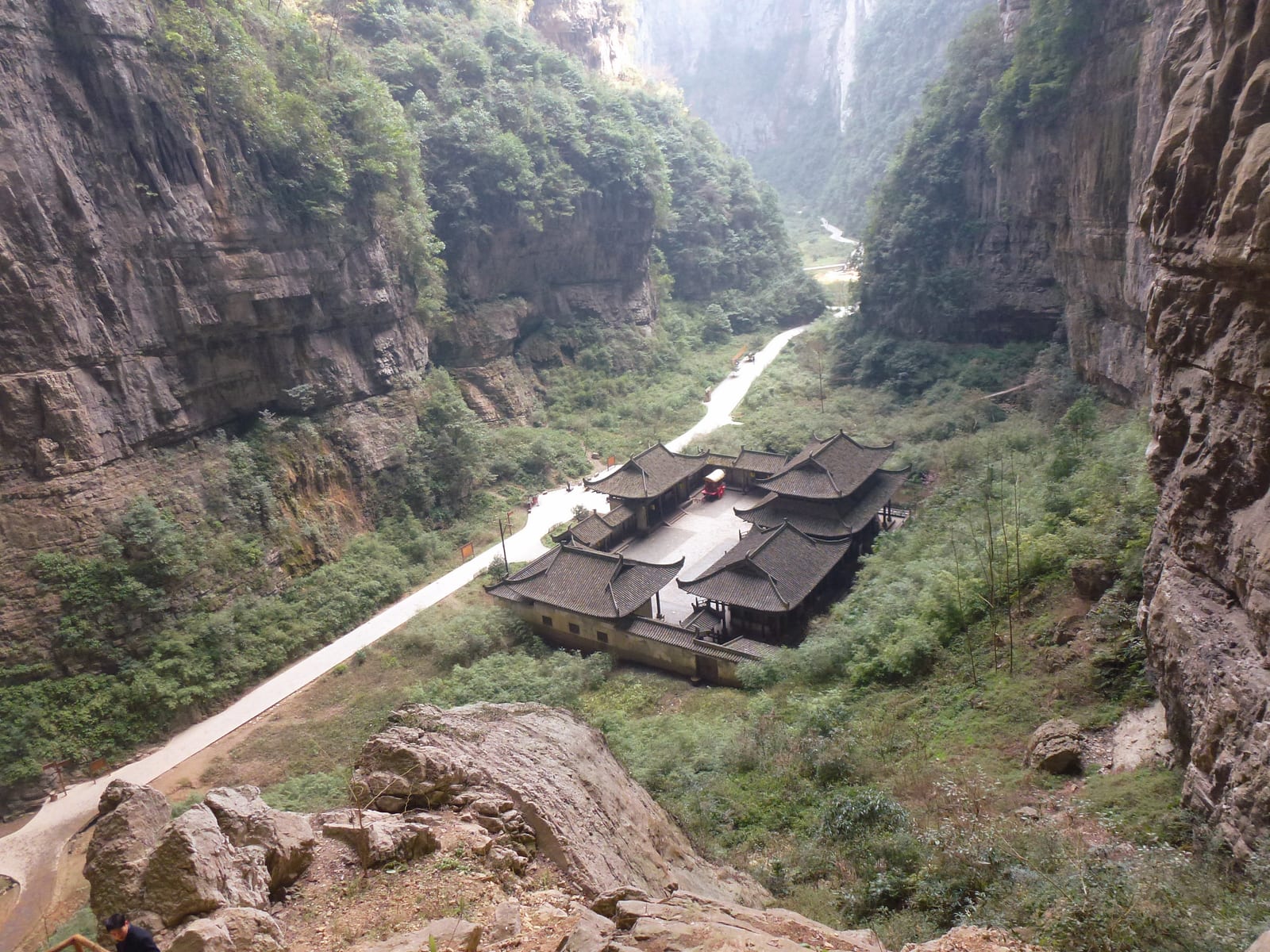
Wulong karst landscapes require a long road or rail approach plus internal visitor transport, so one local night is more dependable than a very long city return. Select Three Natural Bridges, Fairy Mountain or another Wulong site by opening status, weather, walking capacity and the final shuttle; their names on one booking page do not make them adjacent.
Allow two to four days for Fengjie, Wushan, Baidi City and a Three Gorges segment. Water level, weather, vessel operation and pier arrangements can change a sailing. Before payment, identify both piers, included land transfers, cabin or seat, and the cancellation or rerouting terms; cruise photographs do not guarantee visibility.
For ramie weaving, pottery and old-town streets, consider Rongchang as an alternative outer-district trip. Use the Rongchang guide to Xiabu Town opening information and nearby routes before choosing between Antao Town and Wanling Ancient Town, with transport and reservations checked separately. Treat this as an alternative, not an extra squeezed into a full Dazu, Wulong or Three Gorges itinerary.
Itineraries from Two to Seven Days
Two city days: on day one, use Jiefangbei as the base for Huguang Guild Hall or Chaotianmen, then see one Yuzhong night view. On day two, pair Liziba with a Mountain City walk, or combine Ciqikou with one memorial venue.
Three days at a slower pace: devote separate days to Yuzhong and the Shaci area, then use a half-day for Nan'an and the rest for recovery. Leave time between the metro journey and the vertical walking at every change of district.
Four or five days: spend two or three days in the main city plus one full day in Dazu, or use two city days and sleep one night in Wulong.
Six or seven days with the gorges: begin with two or three city days, then move to Fengjie and Wushan for another two to four. Do not place a flight or high-speed train from central Chongqing on the same evening as the planned end of a Three Gorges segment.
Arrival, Metro Travel and Three-Dimensional Navigation
Chongqing Jiangbei International Airport, Chongqing North, Chongqing West and Shapingba railway stations serve different routes and parts of the city. Match the ticket's full station name to the hotel rather than using “Chongqing station” as a catch-all. Take the metro or a licensed taxi for the long leg; with large bags, choose the destination-side exit with a lift.
Two nearby map pins can sit at different heights. Read the metro exit number before leaving the station; the wrong side may add a steep climb or long detour. Use the day's operating notice for cableways, cruises and scenic shuttles rather than an old last-service time. For an outer-district car, agree on operating credentials, insurance, driver hours, parking and overtime charges.
Turn a destination pin into an entrance on an actual street
Do not save only a business name or a pin for an entire building when planning arrival in Chongqing. First decide whether you need the accommodation's reception entrance, a public viewpoint or a meeting place agreed with companions. They do not automatically share an entrance. This is a planning workflow, not a list of current floor entrances, lift locations, opening hours or shortest routes at Hongyadong or another building. A “ground floor” label in an old guide, or a planned connection, is not evidence of a usable route today.
- Ask the actual host about the entrance, not just the floor. Give the accommodation name and address matching this booking and your intended arrival time. Ask for the full street name beside the pedestrian entrance, a door number or identifiable entrance sign, and any stairs, access control or passage through another building. Record the reception floor separately from the outdoor entrance. A matching floor number does not establish that you have found the same street. Do not treat a private garage, residential lobby or another business's door as a shortcut without confirmation.
- Check the main journey and final approach separately. From a station, metro exit or lawful drop-off point to the entrance, write each section as “starting street—connection to the next section—door to enter”. If it depends on a lift, escalator or passage through a building, check both ends, public access and availability for the intended time. Seeing a facility does not verify the whole connection. Choose a safe drop-off location that is permitted at the time; do not ask a driver to stop in a traffic lane, on a bridge or where stopping is prohibited. Save the actual entrance description as well as the destination.
- With luggage or a need to avoid stairs, check the continuous route first. Use the step-free route workflow to link the station exit, drop-off, change of level, entrance and reception; one lift does not establish a usable end-to-end route. If the connection between levels is unconfirmed, ask about another confirmed lawful arrival option. Suitable, trusted luggage storage or dropping this walk can be alternatives to hauling heavy bags along an unverified stair shortcut. Storage does not guarantee step-free access; explain the actual access needs separately.
- If arrival does not match, recheck from a safe public place. If the entrance sign, street or available passage differs from the saved reply, describe the street and visible landmark to the host and clarify the next step. A short remaining distance on the map is not a reason to keep climbing blindly. Do not cross traffic lanes, climb barriers or enter a closed construction area. Do not post room details, orders or companions' live locations publicly. Share only necessary details with a trusted host channel, and follow local pedestrian guidance without blocking an entrance while waiting.
Save the arrival entrance and return meeting point separately
This fictional building example is not a real Chongqing street, floor or map. A traveller is going to imaginary accommodation H. The host confirms a pedestrian entrance on “Upper Street U”. The driver confirms a lawful drop-off on “Lower Street L”, but the public connection from L to U has not been verified. Finding H from both places still does not establish a complete arrival route:
| Place | Known input | What remains unconfirmed |
|---|---|---|
| Arrival drop-off | A safe, lawful location on Lower Street L is confirmed | Whether the traveller can reach Upper Street U from there |
| Reception entrance | Its sign on Upper Street U is confirmed | Whether a usable connection exists from Lower Street L |
| Return meeting point | Not yet chosen | It cannot be assumed to be the reception entrance or original drop-off |
First resolve the missing L-to-U section. If no option can be confirmed, change the drop-off arrangement or itinerary rather than entering “zero minutes on foot” for the missing connection. After arrival, separately choose an identifiable return meeting point where waiting is permitted and onward transport can be reached. Check the route out and the transport pickup location for that time. An entrance, exit or drop-off used on arrival does not guarantee the return arrangements.
Copy this card: purpose and exact business ___; arrival date and local time ___; entrance street/door number/sign ___; reception floor ___; station exit or lawful drop-off ___; each public connection and remaining unknowns ___; luggage and stair limits ___; return meeting-point street and sign ___; next transport location ___; reply channel and time checked ___ . A meeting message should give the street, entrance sign and agreed action, not just a business name or screenshot. Update it when the street or entrance changes rather than keeping contradictory versions.
Where to Stay for the Route
Jiefangbei and central Yuzhong are convenient for a first visit and evening walking, but rooms may pick up noise from shopping streets, crowds or elevated roads. Guanyinqiao works well for dining, shopping and the airport side of the city; Nanping serves Nan'an; Shapingba suits Ciqikou and some rail departures. For a “river-view” room, ask about the actual orientation, floor, obstructions, whether the window opens and the cancellation terms instead of judging from a wide-angle photograph.
Stay in Wulong, Fengjie or Wushan when following those routes. A hotel described as near a station, pier or scenic area may still involve a long slope or vehicle transfer. Establish the real entrance-to-door journey, early pickup, luggage storage and late check-in before booking.
Hotpot, Noodles and the Details on the Bill
Hotpot, xiaomian noodles, jianghu dishes and night-market snacks are part of the city experience, but “mild” does not describe one fixed chilli level. If needed, request a clear broth or divided pot. Before ordering, ask how the soup base, dipping sauce, tea, tableware and service are charged and whether there is a minimum spend. Mention restrictions involving peanuts, sesame, beans, shellfish or offal before food reaches the table.
Prefer restaurants with visible prices and sound food handling; a long queue does not justify over-ordering. For hotpot base, mahua twists or noodle seasoning, read the ingredients, production date, storage instructions and luggage restrictions, particularly for packages containing liquid or oil.
Reservations, Crowds and Non-Negotiable Safety
Use the operator or a clearly authorised seller for the Yangtze River Cableway, cruises, museums, Dazu and Wulong. The booking should identify the traveller, date, meeting point and refund terms. End the transaction if anyone claiming to secure a ticket asks for a verification code, screen sharing or remote control of a device.
Hongyadong, Jiefangbei, Ciqikou and public viewpoints can become densely crowded after dark. Agree on a reunion point before entering and give children a written emergency contact. River steps, piers and Mountain City paths are slippery after rain; remain behind barriers and outside construction or closed areas. In hot weather, pronounced dizziness, nausea or altered awareness is a reason to stop, cool the person and seek help—not a cost to be endured for one more photograph.