A lift icon does not prove a continuous step-free route from hotel door to venue entrance. Nor does “step-free” suit every wheelchair, mobility device, stroller or companion. Verify the chain against actual needs. You do not need to publish a diagnosis; share only necessary access information with the operator.
Use the hotel-location guide to identify the real door and route. For a venue, check booking, opening and entrance rules in the museum travel guide. This article gives no live route or universal gradient, dimension, load, lifting or transfer instruction.
1. Define this trip’s needs before asking for “accessibility”
Write a short needs card containing only necessary information:
- the wheelchair, mobility device or stroller used, whether it folds, and any dimensions or load that the operator must check;
- whether gates, boarding and transfers can be completed independently and where staff are needed;
- companions, children or luggage that change doorway, waiting or boarding arrangements;
- unacceptable substitutions, such as stairs, escalators or being carried by strangers;
- the actual door, travel window, return direction and acceptable backup transport.
Wheelchair and stroller rules need not match, and manual and powered equipment may differ. The operator must confirm fit, load, boarding device and staff process. Arrange assistance involving a person or equipment only with consent. This is not medical, lifting or transfer advice.
2. Split the outward journey into eight connected links
Record each link as start, end, current status and confirmation source:
- Hotel door to street: does the room-side route actually reach the pavement through every threshold, door, ramp or lift?
- Street approach and crossings: do surfaces, kerbs, works and crossings suit this trip?
- Street to concourse: which numbered entrance and lift reach the required concourse? A map icon is not enough.
- Security, gates and concourse to platform: confirm passages, gates, lifts, equipment fit and whether staff must attend.
- Transfer: alighting point, interchange level, connecting equipment and next platform must form one chain.
- Boarding and alighting: confirm meeting point, notification, staff arrangement and any wait.
- Destination platform to exit: verify the specific exit toward the venue, not any available lift.
- Exit to venue entrance: reconnect pavements, crossings, thresholds, security and ticketing to the actual door.
Use four states and record the confirmer and time: CONFIRMED; UNKNOWN; UNAVAILABLE for a confirmed unusable or unsuitable link; and NOT_APPLICABLE only when the route omits it. The last cannot hide failure. No reply, old guide, icon or “probably” remains UNKNOWN.
3. Ask the operator concrete questions
Adapt this script:
On ___ at about ___, I plan to travel from the actual door at ___ to the actual entrance at ___, using ___ and carrying ___. Please confirm the numbered street entrance, route from concourse to platform, transfer, boarding arrangement and destination exit as one continuous route. Where is staff assistance required, how is it requested, where do we meet, and how is the expected wait confirmed? If equipment or an entrance is unavailable, what alternative suits this device and group? Must the return be arranged separately?
A 2022 Beijing Government historical page described advance or on-site requests and staff contacting transfer and destination stations for continuing service. It supports staff contact and linked stations, not 2026 equipment status, coverage, wait time or nationwide practice. Recheck with the operator.
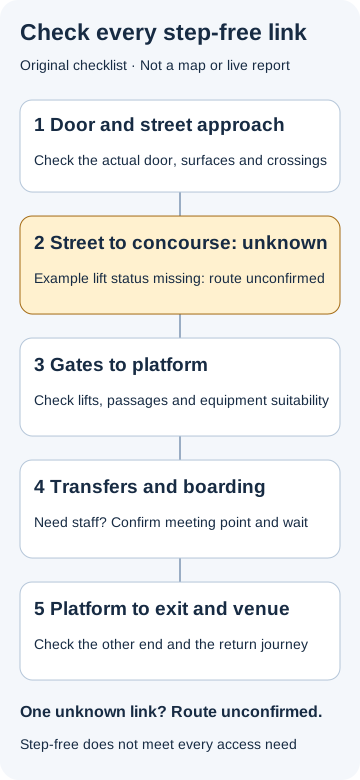
4. Stop when any required link is unknown
This fictional comparison is not a real map, station or measured journey.
Route A has an 18-minute map estimate, but the lift from street to concourse is UNKNOWN. Its decision is HOLD: do not rank the 18 minutes and do not treat missing time as zero.
Route B has a 26-minute estimate. Every segment suits the example, but staff assistance is needed and its wait is unknown. The decision remains WAIT_CONFIRMATION, not “reachable in 26 minutes”. It can enter the plan only after the staff-assistance wait and separate return are confirmed. The estimate is no arrival guarantee.
This does not prove B is better. A may become viable; B’s wait may make it unusable. Remove broken and unknown chains before comparing time, transfers and fallbacks.
5. Check the return as a separate route
The reverse may use a different entrance, concourse, platform, lift or staff arrangement. Copy the outward table and verify every return link through to the hotel door, pickup point or onward terminal—not merely a station exit.
Venue opening, reservation, entry window and device rules are separate. Step-free transport does not issue a ticket, and a ticket does not prove continuous access. Both must remain valid; any change triggers a route check.
6. Recheck before departure and stay in a safe public area after a fault
Near travel time, recheck entrances, equipment, works, staff meeting point and wait. If a lift or confirmed chain is unavailable, remain in a safe, staffed public area and use the on-site button, service desk or operator’s current channel. Never enter a closed passage or substitute stairs, an escalator or being carried by strangers.
Recheck ground transport: pickup, device space, boarding, reservation, drop-off and onward entrance. An ordinary taxi or ride-hail is not guaranteed to carry a device or provide a transfer. If unconfirmed, change or cancel the segment.
7. Copyable link-by-link checklist
- Date, time and necessary needs the traveller agrees to record:
- Four states only;
NOT_APPLICABLEmeans the route omits that link: - Actual hotel door → street: status, source, confirmation time:
- Street and crossings: status, works/weather recheck:
- Street → concourse: numbered entrance, equipment, status:
- Gates/concourse → platform: passage, equipment, staff:
- Transfer and boarding: meeting point, notification, confirmed wait:
- Destination platform → specific exit: status, backup exit:
- Exit → actual venue entrance: status; opening and booking separate:
- Return: all eight links checked again:
- Owner and next check time for every
UNKNOWN: - Safe contact point and confirmed alternative after equipment failure:
The historical source was checked on 25 September 2026. The link model, status terms, script and fictional comparison are original HeTuZhi editorial methods, not a live access report, accessibility certification or suitability guarantee.