Having half a day after checkout does not mean you can leave a suitcase somewhere and sightsee until departure. The full chain has to work: the location must accept your bag, you must be able to deposit and collect it at the relevant times, the return route must reach the correct departure entrance, and a failed deposit must not make you miss the train or flight. This guide recommends no particular hotel, station or storage platform and does not promise same-day capacity. It gives you a process to verify against your own booking, maps and official information.
Use the hotel-location tutorial to choose an area, the train-packing guide to check what you can carry, and the itinerary-planning tutorial to place collection back into the day. This page covers only the checkout–storage–collection–departure task.
1. Write down four inputs before searching for storage
Start with your confirmed information, not a search for “storage near me”:
- Departure point: the exact station, terminal, pier or pickup point, plus the date and time on the ticket. At a large hub, record the relevant terminal or entrance rather than only the city.
- Arrival target: after checking the operator, venue and your own access needs, decide when you need to reach which point. Security, walking inside the hub, checked baggage and assistance can require separate time. There is no universal arrival margin for every journey.
- Bag conditions: number of pieces, approximate size and weight of the largest item, fragile or temperature-sensitive contents, and the documents, wallet, medication and devices that must stay with you.
- Final activity: its real exit, planned finish time, and door-to-door routes from that exit to storage and from storage to the departure entrance.
For children, limited mobility, fatigue or timed medication, include lifts, toilets, rest and a realistic walking pace. A plan is not workable if it depends on a companion rushing beyond their needs.
2. Compare a hotel, a hub facility and another storage point
No category always wins. Ask every candidate the same questions:
On narrow screens, scroll the table sideways to read all columns.
| Candidate | Possible advantage | What you must confirm through a trusted channel or on site |
|---|---|---|
| Checkout hotel | No morning suitcase move; familiar entrance | Whether post-stay storage is accepted; how guest status is checked; item, size and content limits; price; final collection time; any break in desk access |
| Official station or airport facility | Collection may be close to departure | The exact station or terminal; which side of security or gates; current service time, capacity, sizes, prohibited items, charging unit and overdue process; route to the actual entrance |
| Commercial counter or smart locker | May be near the final activity | The exact shop or cabinet, not just a brand pin; reservation and same-day size availability; network, collection code, identity check and staffed help; what happens if it is closed or unavailable |
A map icon, a platform button, a hotel booking note or an old travel post is not confirmation that your bag can be deposited and collected that day. Prefer the venue's official page, a trusted contact inside the booking, or current on-site notices. Record the date, channel and exact branch or terminal. Treat “it should be fine” as unconfirmed.
A Shanghai introduction to its trial standard for luggage storage in specified commercial settings lists fields that should be displayed: prohibited items, charging method and price, service time, maximum duration, process, emergency handling and locker dimensions. It also discusses necessary personal information, storage receipts and identity checks at collection. That is a Shanghai-specific standard, not proof that every hotel or storage point in China offers the same service. Beijing Capital International Airport's official storage page likewise separates location, item size, price and service time. It illustrates why you should check the exact venue's official page; it does not establish conditions elsewhere.
3. Reject options that cannot close the loop
Do not leave these gaps for the final hour:
- The property cannot confirm post-checkout storage, or your bag size or contents may be unacceptable.
- Its collection deadline is earlier than your safe return, or the counter will be behind security, gates or in another terminal when you return.
- You know a straight-line distance but not the actual exit, floor, lift, walking route or repeated security process.
- Only a companion who has already left can use the receipt, or a dead phone or network failure would leave no staffed route to help.
- There is no fallback for closure, full capacity, equipment failure or an activity delay.
For the remaining options, work backwards:
Latest activity departure = planned arrival at the departure entrance − uncertainty margin − storage-to-entrance journey − collection process − activity-to-storage journey
The collection deadline creates a second limit. Calculate both and use the earlier result. Do not add walking or waiting twice if a route estimate already includes it, and do not enter zero for an unknown time.
4. Invented example: one departure, two storage locations
Every number below is fictional. It is not a real city, station, hotel, train or service time.
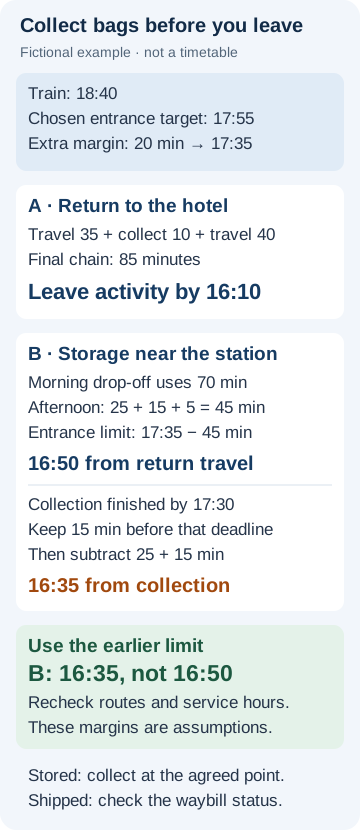
Assume a train leaves at 18:40. After checking their own booking and station information, the traveller chooses 17:55 as the target for the correct station entrance. They keep another 20 minutes of route uncertainty before that, so the planned entrance arrival is no later than 17:35. They can choose when to leave the final activity.
Option A: leave the bag at the hotel
- Activity exit to hotel desk: 35 minutes.
- Receipt check, collection and piece count: 10 minutes.
- Hotel to exact station entrance: 40 minutes.
- Final chain: 35 + 10 + 40 = 85 minutes.
- Latest activity departure: 17:35 − 85 minutes = 16:10.
Also suppose the hotel confirms that collection must be complete by 17:30 and the traveller keeps 15 minutes before that cutoff. Collection should finish by 17:15, giving 17:15 − 10 − 35 = 16:30. A 16:10 activity departure reaches the hotel at 16:45 and completes collection at 16:55, before 17:15. The station-arrival calculation is still earlier, so A uses 16:10. Without a confirmed cutoff, A is not an eligible option.
Option B: deposit it in the morning at a confirmed staffed point beside the station
- Morning hotel to storage: 30 minutes; acceptance: 15; storage to activity entrance: 25. The morning move uses 70 minutes.
- Afternoon activity exit to storage: 25 minutes; collection: 15; storage to station entrance: 5. The final chain is 45 minutes.
- Based only on the station-arrival target, the activity could end at 16:50.
Add one fictional condition: B has confirmed that collection must be complete by 17:30. Keeping 15 minutes before that deadline means finishing collection by 17:15. Subtract the 25-minute trip and 15-minute collection process, and the activity must end by 16:35. B's actual limit is therefore 16:35, not 16:50.
B permits a departure 25 minutes later from the activity but uses 70 minutes to move the bag in the morning. A keeps the morning simple but requires a long afternoon detour. The real choice depends on the day's route, energy, transport and confirmed service—not a rule that station storage is always better. Recalculate after a delay; do not spend the time already reserved for collection and departure.
5. Keep “stored” separate from “checked or shipped”
Storage means returning to the same point for the bag. Checked baggage, courier delivery and station-to-door transport move it elsewhere. Their receipts, statuses and collection locations are different.
When storing a bag:
- Confirm the piece count and outer condition together, obtain a tag, locker record or electronic receipt, and check the identifier immediately.
- Provide only information necessary for the service. Do not post identity numbers, booking numbers, collection codes or tag barcodes publicly or forward them casually.
- Keep passports, identity documents, wallet, keys, necessary medication, valuables and essential devices securely with you. Check the location's own prohibited-item notice rather than assuming one universal list.
- At collection, count the pieces and inspect the outside before leaving. If something is wrong, record it and follow the provider's on-site process. This guide neither assigns liability nor promises compensation.
If you use transport instead, record where the waybill is stored securely, the destination, carrier, acceptance time, official tracking channel and actual status. “Accepted” is not “arrived.” Do not mark the movement complete merely because you have gone sightseeing. China Railway's official high-speed convenience-shipping page describes a specific station-to-door service, including waybill entry and tracking; it is not temporary station storage and does not prove that your station can accept the item that day. Other railway baggage transport is likewise a transport process rather than left luggage; check its current official page, ticket and eligible handling locations separately.
Match each bag to its receipt and authorised collector
Before handing over the bags, give each one a reference label for your group's checklist. Record its appearance, the total number of bags, the exact storage location, where the receipt is safely stored, and the provider's requirements for you or someone collecting on your behalf. Do not copy collection codes, barcodes, identity numbers or booking numbers into a shared list. You can keep a checklist without those sensitive details in the offline travel kit. Ask the provider privately whether one receipt can cover several bags, whether bags under one receipt can be collected separately, whether a screenshot is accepted and whether another person may collect them.
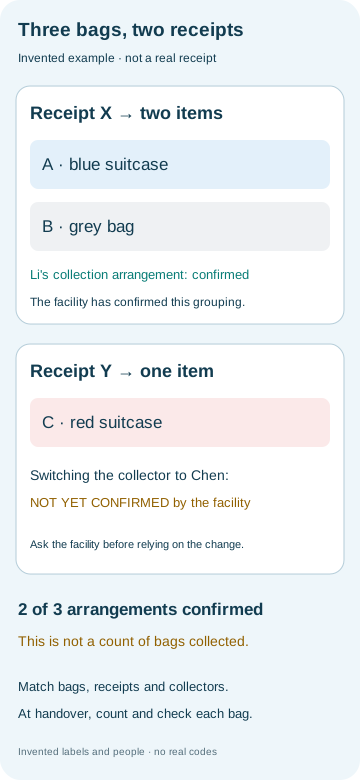
This example is entirely invented; bag labels, people and receipts identify nobody real:
- A, blue suitcase: Receipt X; Li as collector; arrangement CONFIRMED.
- B, grey bag: Receipt X; Li as collector; arrangement CONFIRMED.
- C, red suitcase: Receipt Y; change to Chen as collector; arrangement PENDING.
The storage point has confirmed that Receipt X covers both A and B and that Li may collect those two under its requirements. C uses Receipt Y, but the change to collector Chen has not been confirmed by the point. Only the A and B collection arrangements are confirmed; C remains pending. Two receipts do not mean two bags, and a confirmed arrangement does not mean collection has occurred.
At collection, present the actual receipt and any verification documents the provider requires, then match each bag to your checklist, count the bags and check their condition. Your own labels do not replace the provider's tags or receipts. After the handover, confirm the collection status through the provider's process and mark each row in your own list as collected or not collected. A successful scan, a forwarded message or a read receipt does not prove that the bags have been handed over. Ask staff to resolve any mismatch in bags, condition, receipts or collector, and leave unresolved items marked needs attention. Recalculate the return margin in Section 3; do not skip checks or rush unsafely to catch your departure.
A Shanghai Jing'an District Government introduction dated 8 July 2024 discusses receipts, distinguishing luggage and collection verification in a trial standard for specified Shanghai commercial settings. Rechecked on 26 September 2026 Beijing time (25 September UTC), it does not show that every current storage point nationwide follows the same process. The steps and invented checklist here are editorial checking tools, not official universal rules.
6. Back up closure, full capacity and failed collection
Choose a fallback before handing over the bag, with a clear trigger time:
- Closed, full or wrong size before deposit: never leave luggage at a doorway, beside a desk or unattended. Return to the hotel only if it has confirmed acceptance; otherwise cancel the final activity, take the bag to the departure point and ask current official services there.
- The activity is running late: leave when the trigger time arrives and add nothing else. A companion may collect first only if everyone agrees and the receipt and identity rules allow that person to do so.
- Locker or collection-code failure: use the official help method displayed on site while recalculating the journey with the worst plausible delay. Never give an account password, SMS verification code or complete identity-document image to a stranger.
- The bag has entered a transport service: use the waybill's official tracking and delivery arrangement. Do not keep searching at the original storage point under the old plan.
If no option can be confirmed, the reliable decision may be to shorten or cancel the final activity rather than rely on an unverified nearby alternative.
7. Copyable checkout-day storage checklist
- Checkout date and time:
- Departure date, service and exact entrance:
- Entrance-arrival target based on current operator/venue information:
- Extra uncertainty margin:
- Number of bags; largest size/weight; contents needing confirmation:
- Documents, medication, valuables and devices kept with you:
- Full storage name, address, floor/terminal and side of security or gates:
- Information source, confirmation date and trusted contact:
- Post-checkout/non-guest storage accepted:
- Reservation required; reservation still subject to capacity or equipment status:
- Charging unit, overdue terms and maximum duration:
- Prohibited items and size limits:
- Type of identity check required (do not copy the identity number here):
- Receipt type, authorised collector and staffed help method:
- Current service time; latest start and completion times for collection:
- Final activity exit to storage:
- Collection-process estimate:
- Storage to exact departure entrance:
- Latest activity departure under both limits:
- Trigger and fallback for closure, full capacity, equipment failure or delay:
- If transported: secure location of the waybill receipt (do not copy the full number into a shared checklist), carrier, destination, official tracking channel and current status:
Official material was checked on 25 September 2026. Service times, locations, capacity, prices and handling conditions can change; verify them before departure and again before depositing the bag. The workflow, formula and invented example are editorial planning tools, not a guarantee of storage availability, transport time, legal responsibility or compensation.