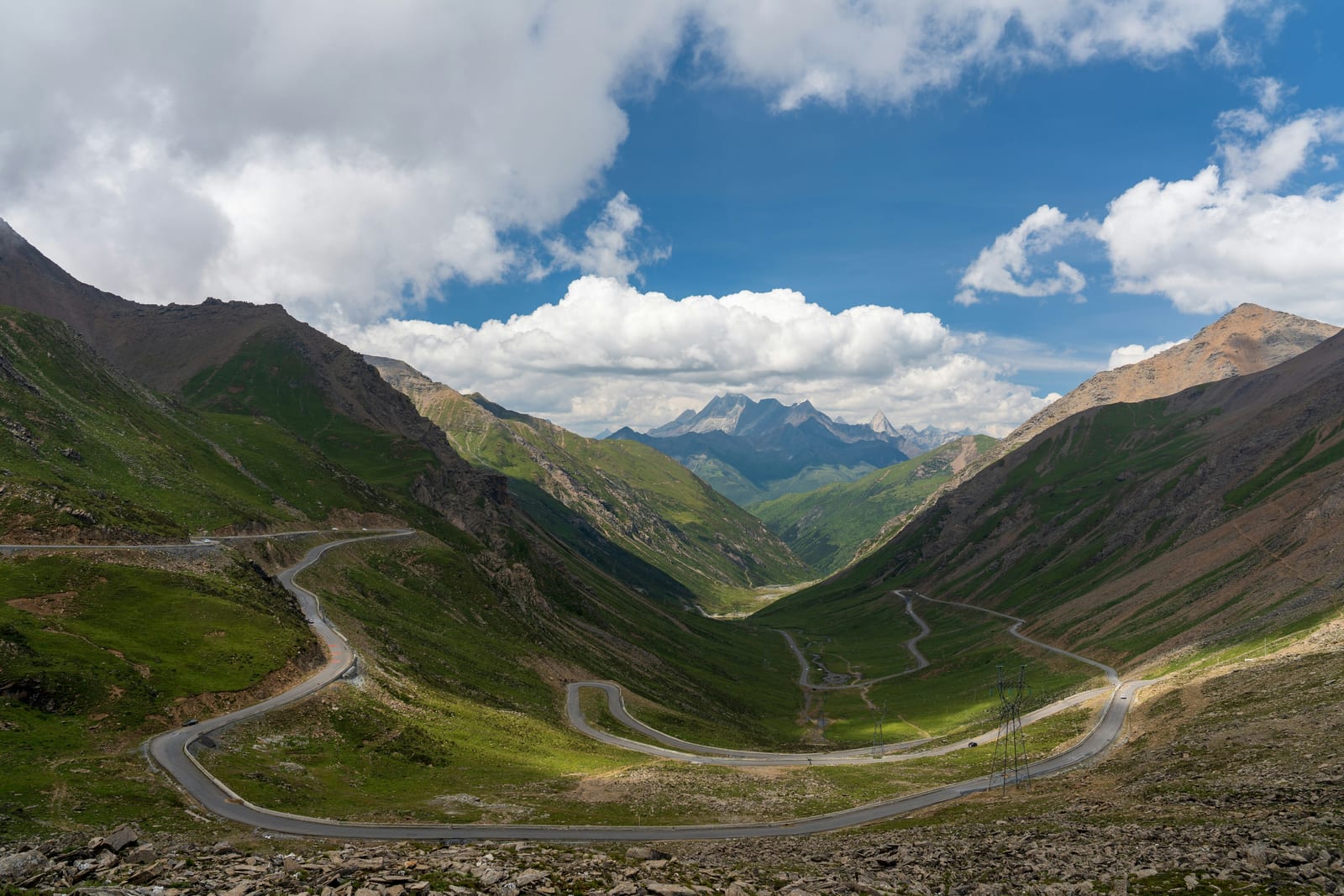
A scenic drive is not a ranking of photographs. From Hainan’s coast to the Hexi Corridor, a route has to offer more than one viewpoint: its public roads must be open, its town spacing must suit the vehicle, and an ordinary driver must be able to complete it with a safe margin. Coasts, grasslands, desert corridors and plateaus are visually distinct journeys with equally distinct demands. Use these route families to make the first choice, then use the general road-trip guide for vehicle and incident procedures.
Filter by experience, season and time
For a first long drive, look to Hainan’s paved coast, southern Anhui hill country or another old-village circuit with frequent towns and alternative rooms. If only one person is driving the Hexi Corridor, reduce the number of route stops and the total distance while keeping enough overnight rests, rather than filling every day to the navigation app’s estimated limit. A Qinghai, Xinjiang or border route is not the premium edition of an easy trip; altitude, desert or ice changes the health, vehicle and exit decisions.
Spring and autumn suit many lower-altitude corridors in Fujian and southern Anhui. In summer, Hainan and Fujian need typhoon monitoring, Huangshan-area roads need heavy-rain and geological-hazard checks, and Hulunbuir or Xilingol adds lightning and fire controls. An Altay winter route calls for appropriate tyres, real cold-weather experience and generous time. Use two or three days for a local loop, five to seven for one regional corridor, and seven to ten or more for a cross-province drive with recovery days.
Five route families
- Coasts and islands: Hainan, Fujian and the Jiaodong Peninsula offer frequent towns, but typhoons, rough seas, ferries, shore parking and holiday traffic can reorder the route.
- Old villages, hills and river country: Jiangnan, southern Anhui, Qiandongnan and Xiangxi have dense lodging and food. Narrow lanes, fog, rockfall, village parking and residents' private space are the trade-offs.
- Grasslands and forests: Hulunbuir, Xilingol and north-eastern forest regions bring wide views and long stages. Fire restrictions, pasture access, wildlife, border photography and fuel or charge deserve more attention than a photo stop.
- Desert and heritage corridors: The Hexi Corridor links recognisable town nodes, heritage sites and landforms, but the gaps are long and the Gobi is not an open off-road area.
- Plateaus and high mountains: Qinghai, western Sichuan, north-western Yunnan and Xinjiang passes combine powerful scenery with altitude, snow, rockfall, weak communications and distant medical care.
Route examples that can be planned
Hainan east coast or island loop
Haikou, Wenchang, Qionghai, Wanning, Lingshui and Sanya form a practical east-coast spine. A first visit can choose three or four overnight locations instead of circling Hainan. A mainland vehicle requires current ferry, paperwork and weather checks; an arrival-day rental requires accepted documents, insurance, mileage, pickup and one-way-return terms. Beaches, reefs and closed construction roads are not driving surfaces, and a typhoon or severe thunderstorm removes the shoreline leg.
A slower Fujian coast
Xiapu, Fuzhou, Pingtan, Quanzhou, Xiamen and Dongshan are ingredients, not a compulsory sequence. Xiapu calls for respect around aquaculture and working fishing villages, Pingtan exposes a route to strong wind, and Quanzhou or Xiamen can each justify two nights. Roads do not trace every metre of the sea; a promised “coastal highway” is no reason to enter a working port, fish-farm access or narrow village lane.
Jiaodong Peninsula cities
Qingdao, Weihai and Yantai can be driven from home or broken into a rental after arriving by rail or air. The intercity roads are established, but waterfront parking, holiday congestion, sea fog and wind can make the map optimistic. In central Qingdao, leaving the car at the hotel and using public transport is often more scenic than queuing for every shore space.
Southern Anhui villages and hills
Huangshan City, Hongcun, Xidi, Yixian, Shexian and Jixi can be combined around architecture, walking or food. Roads between the villages are not expressways, and rain, bends, fog and holiday gates consume time. A county-town room simplifies access; a Hongcun or Xidi stay trades that convenience for atmosphere and therefore needs clear parking, luggage, late-arrival and noise arrangements. Stone alleys, courtyards and controlled village entrances are not navigation shortcuts.
Hexi Corridor heritage and landforms
Zhangye, Jiayuguan and Dunhuang connect grottoes, frontier history, colourful landforms and the Gobi, but every move is substantial. Use one principal visit per day and reach the room before dark, after checking tickets, road status and fuel or charge. Mogao cave areas, border facilities, railway infrastructure and drone use all follow local rules; a landform photograph never warrants leaving an open road.
Qinghai and western Sichuan plateaus
Xining, Qinghai Lake, the Qaidam region and western Sichuan's smaller loops are often sold under one “classic route” label, even though altitude, services and seasonal exposure change from stage to stage. On a first plateau visit, do not combine rapid ascent, a long drive and a dawn chase. Persistent or severe altitude symptoms require an end to the ascent, prompt descent and appropriate medical help; snow, rockfall, traffic controls or closure means following the official return, not an unmarked side road.
Turn days into a workable rhythm
Two or three days
On a short Hainan east-coast segment or southern Anhui village loop, reach the place where you will stay on day one, make a local circuit on day two and keep half of day three for the return. The last stop should be optional, and the same hotel can serve both nights.
Five to seven days
On the Fujian coast, Jiaodong Peninsula or Hexi Corridor, choose two or three overnight locations and spend at least one or two nights in each. A transfer day carries only a short visit, not a major hike, water activity, late event or inflexible entry. The middle of the trip needs half a day for laundry, supplies and a vehicle check.
Seven to ten days
For a Qinghai plateau, western Sichuan or long Xinjiang route, set the endpoints and one-way vehicle arrangement before filling the itinerary. Rest after two or three consecutive driving days and retain a weather or repair day. When the route shrinks, preserve the return and confirmed rooms instead of forcing the loop.
Vehicle, rental and electric-car choices
Most paved Hainan, Fujian and Jiaodong routes do not need a large off-road vehicle; excess width can make village or city parking the day’s hardest task. Four-wheel drive also cannot answer every Qinghai plateau, Altay ice or Gobi-edge problem; tyre condition, clearance, low-temperature ability, driver experience and road opening remain separate tests.
A rental agreement should settle the accepted licence and documents, actual category, liability, deposit, mileage, provincial limits, one-way return, violations and assistance. Photograph the body, tyres and dashboard before leaving the branch. An electric vehicle needs reserve for motorway speed, temperature, gradients and queues; a charger shown on a map may be unavailable or occupied, while hotel charging still needs connector, power, tariff, hours and move-after-charging terms.
Lodging, food and reservations
In Hongcun, Xidi, Hainan or Hulunbuir, parking, late arrival, heating or cooling, hot water, breakfast and cancellation come before a view. A southern Anhui village room adds luggage access, a Hainan island stay adds ferry disruption, and a Qinghai or Hulunbuir property adds phone service, power, water and weather questions. A promotional photograph does not prove the distance from the road, reception or attraction.
Choose clearly priced restaurants where hygiene can be assessed and ingredients are properly cooked. For seafood, ask whether pricing is by item or weight and what preparation costs; on routes known for large shared dishes, clarify portion size before ordering. Keep the contracting entity, inclusions, insurance, refund and weather terms separately for a ferry, hired car, campsite, guesthouse or outdoor operator.
Photography and land boundaries
A usable viewpoint on the Jiaodong coast, Qinghai Lake or the Hexi Corridor includes lawful parking, a walking route and a safe return to the car. A blind bend, bridge, tunnel mouth, emergency lane or soft verge does not become a lay-by because the light is good. Hulunbuir pasture, Fujian tidal flats, Qinghai salt lakes and Gobi tracks may be protected, productive or private land; old tyre marks grant no access.
Drone use must satisfy airspace, border, airport, military, attraction and nature-reserve controls at the same time. In a lived-in village, residents, children, religious activity and courtyards are not public sets. Carry waste out, keep fire away from forest and grassland, and never crush vegetation to reproduce a social-media frame.
Breakdowns, weather and an exit plan
Each morning on the Hexi Corridor, Qinghai plateau or Hulunbuir grassland, refresh the forecast, open roads, fuel or charge, tyres and next room. On remote Gobi or Qinghai roads, offline mapping, water, warmth, sun protection, first aid and communications stay within reach. A convoy should agree exact meeting points, a lost-contact wait and who calls a reroute instead of driving nose to tail.
On an expressway, follow current traffic-police instructions: move the vehicle only when safe, warn traffic as required, get people away from live lanes and call for help. Injury, damaged infrastructure or an immobile vehicle needs prompt official assistance. Current official weather and geological-hazard warnings for intense rain, flash floods, rockfall, dust, blowing snow, ice or dense fog may make the last safe town the correct destination.
Final checklist
- The chosen Hainan, Hexi Corridor or other route has a main line, an alternative and a latest turnaround.
- Navigation time has been expanded for meals, charging, parking, queues and photographs.
- Fuel, charging, rooms, toilets, medical care and mobile-service gaps are marked.
- Tickets, ferries, rental, hired vehicles and accommodation have separate operators and refund terms.
- Every traveller accepts that Qinghai weather, a Hulunbuir fire warning, illness or a vehicle fault can cancel the day.
- Current road and attraction notices—not social-media photographs—support the planned Fujian, Jiaodong or plateau route.