A shared travel ledger is not the trip total divided blindly by the number of travellers. A room may be split by bed use, only two people may join a dinner, and A may front a shuttle that only C uses. This guide uses one invented CNY example to keep “who paid” separate from “who used it,” then turns received refunds into checkable net balances.
If the trip has not begun and you need to decide whether it is affordable, start with the budget-travel guide. To test whether a remote room will add local transport costs, use the hotel-location tutorial. This page is for reconciling expenses that have happened. It is not a price guide, currency converter or decision about anyone's legal liability.
1. Agree the shares before paying
Write down the rules for this trip and for the relevant purchases. No one needs another traveller's bank details to do this.
- Choose the participants for every line. A person who did not eat the meal, take the ride or use the room does not automatically share it merely because they are in the trip group.
- The payer is not necessarily the consumer. Put the person whose cash or account paid in the payer column. Put every user and their amount in the shares columns. The same person can appear in both places.
- Unequal splits are valid when the group agrees. Use exact amounts, percentages or units, but each line's shares must add up to that line's amount. If percentage rounding leaves one or two cents, agree who takes the remainder instead of hiding it at settlement.
- Set boundaries for partial participation. For someone joining late or leaving early, identify the first and last room night, shared vehicle or group purchase they join. “Two days on the trip” is too vague to determine every line.
- Remove personal shopping. Souvenirs, personal medicine and individual upgrades stay outside shared costs unless other people expressly agree to share them. If one traveller fronts the purchase, assign the share only to its actual user.
2. Give every expense six fields
| Field | What to record |
|---|---|
| Item and date | “Two-night stay, 3 October,” not just “hotel” |
| Actual amount | The amount paid, not an estimate or a discount that has not arrived |
| Payer | Whose cash or account actually paid |
| Participants and shares | Each person's amount; enter zero for a non-participant |
| Status | Paid, needs checking, refund requested, refund received or voided |
| Evidence reference | A redacted order suffix, filename or group-message time, not full sensitive data |
The US Consumer Financial Protection Bureau's educational spending tracker recommends retaining receipts, or writing down an expense when there is no receipt, before adding totals. It also warns against putting names, account numbers or similar sensitive information into such worksheets. This guide borrows only the method of recording actual spending before totaling it; the US material is not presented as Chinese law.
3. Worked example: different users, one ledger that still balances
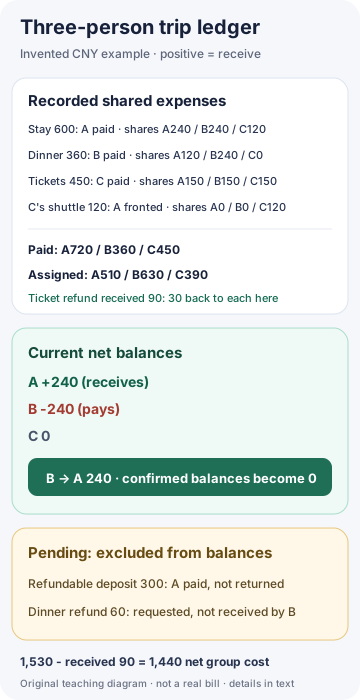
Every number below is an invented, single-currency CNY exercise, not a quote for any city. A, B and C agree that the accommodation uses two, two and one shares; only A and B attend the dinner and accept exact shares of CNY 120 and CNY 240; the tickets are equal; and A fronts a shuttle used only by C.
| Completed item | Amount | Payer | A's share | B's share | C's share |
|---|---|---|---|---|---|
| Two-night stay | CNY 600 | A | CNY 240 | CNY 240 | CNY 120 |
| Dinner attended by A and B | CNY 360 | B | CNY 120 | CNY 240 | CNY 0 |
| Tickets for all three | CNY 450 | C | CNY 150 | CNY 150 | CNY 150 |
| Shuttle used only by C | CNY 120 | A, fronting | CNY 0 | CNY 0 | CNY 120 |
| Gross total | CNY 1,530 | A 720 / B 360 / C 450 | CNY 510 | CNY 630 | CNY 390 |
A also buys CNY 80 of personal goods, which are excluded. A pays a CNY 300 refundable accommodation deposit that has not been returned. Record it as “deposit held,” not as part of the CNY 1,530 expense total. This preserves the distinction between cash temporarily unavailable and a confirmed final cost.
C later receives a CNY 90 partial refund for the tickets. Because the original ticket cost belonged equally to all three, reverse CNY 30 for each original participant; do not give the whole benefit to C merely because C received the money. Keep the original CNY 450 line and add a separate “CNY 90 refund received” line. That audit trail is clearer than silently changing the original expense to CNY 360.
A separate CNY 60 dinner refund has been requested but has not reached B's account. It remains in the pending-refund list and changes nobody's balance. In this example, the travellers agreed that if it arrives, it will reverse the original dinner shares: CNY 20 for A and CNY 40 for B. Recalculate while retaining every prior settlement payment. This is the agreement for this example; a refund expressly belonging to one person's item must not automatically be spread across the whole group.
4. Net-balance formula and one settlement payment
Use a positive number for “this person should receive” and a negative number for “this person should pay.” Include only completed expenses and refunds actually received:
Net balance = shared expenses paid - assigned expense shares - shared refunds received + assigned refund benefit + prior settlement payments made to travellers - prior settlement payments received from travellers
- A: 720 - 510 - 0 + 30 = CNY +240.
- B: 360 - 630 - 0 + 30 = CNY -240.
- C: 450 - 390 - 90 + 30 = CNY 0.
The balances add to zero, so the internal ledger conserves the full amount. Check it from the cost side as well: CNY 1,530 gross spending minus the CNY 90 received refund is CNY 1,440 net group cost. The final costs are A 480, B 600 and C 360, also totaling CNY 1,440.
There are no earlier settlements in this example, so the formula's final two terms are zero in the first calculation. Only one payment is needed for the currently confirmed entries: B actually pays A CNY 240. Once receipt is confirmed, that payment changes A's balance by -240 and B's by +240, leaving A, B and C at zero for those entries. Within this travel-sharing ledger, repayment closes a balance; it is not recorded again as new income for A or another travel expense for B. Doing so would double count it. This is not a tax or general accounting classification.
The CNY 300 deposit and CNY 60 pending refund are still open, so “zero now” does not mean the trip can never change. Suppose B has paid the CNY 240 and the CNY 60 dinner refund later reaches B. Expenses and refunds alone would then show A +260 and B -260. Put the prior B-to-A settlement payment back into the full formula: B has already paid 240 and A has already received 240, leaving A +20 and B -20. B pays A only another CNY 20, not CNY 260.
Splitwise's official explanation of debt simplification likewise says that changing payment paths does not change anyone's total balance. The table, formula and example here are original HeTuZhi editorial material and can be reproduced on paper or in a plain spreadsheet. No particular app or payment channel is required.
5. Keep separate states for refunds, deposits and corrections
- Refund requested: Record the expected amount, original line, request date and current status, but do not alter the net balances. “Initiated” on a merchant screen is not proof that the receiving account has the money.
- Refund received: Add a reversing line against the original expense. Allocate it to the original participants and shares or another ownership rule the travellers confirm; do not spread a refund for one person's item across the whole group automatically. The expense tool's official refund help also treats a refunded shared expense as money to distribute back to the relevant members; it does not resolve any real-world dispute for them. Keep earlier settlement payments in every recalculation.
- Refundable deposit: Track paid, partly returned, fully returned or confirmed deduction. While held, it is tied-up cash rather than confirmed spending. If a deduction is later confirmed, create an expense only for that amount and let the group agree who bears it.
- Withdrawal or correction: Do not erase history silently. Mark the old row “voided—replaced by [new row],” with the editor, time and reason. Recalculate the balances, then determine whether an earlier settlement needs a top-up or a return payment.
6. Reconcile the ledger with money actually received
When the sheet says “B pays A CNY 240,” do not mark the trip settled immediately. Check payer, recipient, amount, date and status first. Add the repayment only after the recipient confirms receipt, then bring both balances to zero.
For cash, both people can confirm “paid” and “received” in the same group message. For an electronic transfer, keep only a redacted reference. A shared ledger does not need a full account name, card number or payment QR code. This guide recommends no financial product, expense app or particular payment rail.
Never send an identity number, full bank-card number or SMS one-time code merely to “check the trip expenses.” Before sharing a booking or receipt, mask names, document numbers, contact details, room numbers, barcodes, QR codes and unrelated orders.
7. Copyable blank travel-expense ledger
Trip:
Ledger currency (no automatic conversion):
Participants:
Settlement date:

Agreement
- Equal split by default? If not, what rule applies?
- How will unequal shares be confirmed?
- Item boundaries for anyone joining or leaving partway:
- Who takes a rounding remainder?

Completed expenses
ID | Date | Item | Amount | Payer | Each person's share | Status | Redacted evidence reference

Pending items (excluded from net balances)
ID | Type (deposit / refund not received / needs checking) | Original expense ID | Amount | Current holder | Status | Next check date

Received refunds
ID | Receipt date | Original expense ID | Amount | Recipient | Each person's refund benefit | Redacted evidence reference

Net balances (positive = receive; negative = pay)
Person | Shared expenses paid | Assigned expense shares | Refunds received | Assigned refund benefit | Prior settlement payments made | Prior settlement payments received | Net balance
Balance sum (must be zero):

Settlement record
Date | Payer | Recipient | Amount | Cash/transfer | Receipt confirmed | Redacted reference

Withdrawal/correction
Old row ID | Status | Reason | Replacement row ID | Editor and time | Balances recalculated
The travellers themselves must agree on shares. If an amount, participation boundary or deduction is disputed, freeze that row and preserve each person's account instead of assigning the disputed amount unilaterally. Where necessary, verify with the booking provider or a qualified professional. This tutorial does not allocate legal responsibility. The official public materials linked above were accessed on 25 September 2026; the worked arithmetic, formula and template are original editorial material from HeTuZhi.