“Central,” “near the metro” and “beside the scenic area” are starting points, not complete directions. A useful location works for your arrival, your repeated daily journeys and your departure with luggage. This guide shows how to compare areas against your own itinerary. It does not rank individual hotels or treat a low price or high review score as proof of safety.
Use it once you have chosen a city. For money, see the budget travel guide; for railway arrivals and connections, use the high-speed rail guide. This tutorial deals specifically with where to stay.
1. Put the trip on a map before searching for rooms
Mark five things: your exact arrival station, terminal or pier; your departure point; the actual visitor entrances of your main sights; the area you expect to use for meals and breaks; and the doors of two or three possible hotels.
Separate confirmed reservations from places you merely hope to visit. An unconfirmed attraction across town should not dictate several non-refundable nights. Check the full branch address: “airport hotel” does not mean a walk to the terminal, and two properties of the same brand are not interchangeable.
Look for the repeated journey. A station-area room may simplify arrival and departure but add a cross-city trip every sightseeing day. For a single overnight stop between a late arrival and an early departure, those two transport connections may matter much more.
2. Check three real routes for each property
Look up arrival point to hotel door, hotel to your main visitor entrance, and final activity to bag collection to your departure point. Use the planned travel date and time where the route planner supports it. Otherwise flag the missing information; a daytime journey does not establish that a late-night connection runs.
Separate walking, waiting, riding, changing services and finding entrances. Check which parts are already included in the route estimate so you do not count them twice. Allow additional time appropriate to your luggage and travelling companions; a navigation estimate is not a punctuality guarantee.
- Near a metro station: identify the usable exit and actual walk, including stairs and lifts. The station's map symbol is not its entrance.
- Inside an old town or attraction: ask where a vehicle can stop and what remains on foot. A room inside a ticketed area does not automatically include admission or repeat entry.
- Beside a large railway station: work from the exit you can actually use. Tracks, barriers or a road crossing may defeat a short straight-line distance.
- Travelling with wheels: confirm the particular entrances, lifts, ramps and vehicle arrangements needed for a wheelchair, pushchair or suitcase. A short mapped route is not proof of step-free access.
For an advertised shuttle, establish the pickup point, hours, booking requirement, charge and alternative if you miss it. Do not count an unconfirmed shuttle as arranged transport.
3. Count repeated journeys, not just distance from the station
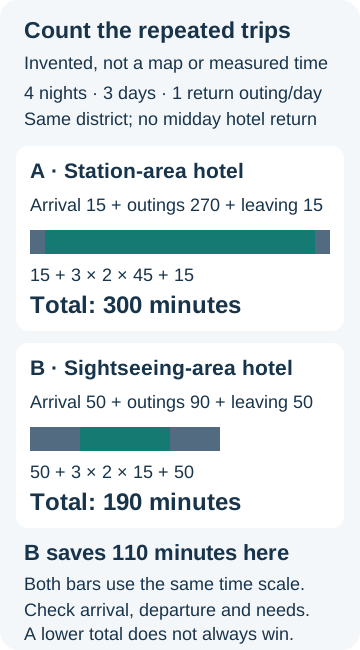
Here is an invented comparison, not a timetable or hotel recommendation. Assume four nights, three complete sightseeing days in the same district, one return outing each day, and no midday return to the room. Arrival and departure are separate journeys. For this example, both rooms already meet your budget and essential requirements, and the transport is available.
- Station-area hotel A: 15 minutes to reach it, 45 minutes each way to the sightseeing district, and 15 minutes back to the departure station. Total: 15 + 3 × 2 × 45 + 15 = 300 minutes.
- Sightseeing-area hotel B: 50 minutes on arrival, 15 minutes each way for sightseeing, and 50 minutes on departure. Total: 50 + 3 × 2 × 15 + 50 = 190 minutes.
B saves 110 minutes under those assumptions, despite its longer station transfers. Add extra trips if you return for a midday break. If each day goes in a different direction, calculate each separately; real outward and return journeys may also differ.
The lower total does not automatically win. An early departure may fall before B's transport starts. Reject options that cannot meet arrival, departure, budget or essential access needs before comparing convenience. Use the room-plus-transport budget method for costs rather than assigning everyone's time the same cash value.
4. Test the awkward journey first
Late arrival: establish legitimate onward transport, reception or self-check-in arrangements, and what happens if you are delayed. A “late arrival” note is not confirmation from the property. If arrival crosses midnight, give the hotel the full date and time and ask which night to book; do not infer it from the date showing on your phone.
Early departure: work backwards from the operator's station or airport requirements, adding checkout, bag collection, the transfer and a suitable margin. The driving time alone is not your complete departure allowance. If the first public service is too late, confirm another legitimate option or change the accommodation or journey.
Sightseeing after checkout: ask whether storage is available after your stay, its cost, collection deadline and access hours. Then check the whole route from your final sight to the bags and onward to the station. Keep documents and valuables secure with you; storage availability is not an insurance guarantee.
Changing hotels adds packing, checkout, transport, storage and waiting for a room. Compare that full process with a direct departure from the original hotel before moving just to be closer to a station. A party's rest and access needs may outweigh the smallest total journey time.
5. Confirm the room and booking, not only the map pin
Daxing'anling's market regulator advises reading room, price and cancellation information, keeping the booking page and reconfirming with the hotel. This is booking preparation, not a promise of free cancellation.
Ask specific questions: “We expect to arrive on this date at this time, with this room type and number of guests. Is the reservation confirmed at this address? Where is the entrance or lift we need? What are the arrival and departure arrangements?” Use trusted contact channels and share only necessary details; never post identity documents, order numbers or room numbers in public reviews.
List non-negotiables separately from preferences: beds and occupancy, windows and noise, entrance and lift access, breakfast portions, parking or storage, deposits and extra charges. A request for a quiet room may be worth making, but “we will try” is different from a confirmed room entitlement.
Record the precise cancellation deadline and conditions, then recheck transport and attraction reservations before it. The Jilin Consumers Association's accommodation reminder also emphasises confirmation and keeping evidence. If the address changes, no room is available or charges are unclear, contact the hotel and original booking channel and retain payment and communication records. This guide does not determine a dispute or promise compensation.
6. Copy this checklist for each shortlisted property
- Full property name, address and trusted contact:
- Check-in and checkout dates; expected arrival time:
- Arrival point to hotel: transport, walking, changes, estimate and unresolved details:
- Each day's hotel-to-sight-and-back route, trip count and estimated time:
- After-checkout storage, cost and collection deadline:
- Last activity to bags to departure point, including when to leave:
- Essential room and access requirements, and what is confirmed:
- Room, transfers, storage and necessary extras; refundable deposit listed separately:
- Cancellation deadline, conditions and next review time:
- Any unacceptable gap, and whether a dependable alternative exists:
Choose a location that makes the whole trip workable rather than seeking a perfect score in every category. For city-break ideas, continue to weekend trips. If transport, weather or official safety instructions change, reassess the route rather than preserving an unsafe plan to protect a room booking.
The comparison method, checklist and invented example are editorial planning tools, not an official rating system. The two consumer reminders were consulted on 24 September 2026. Confirm facilities, transfers, prices and terms for the actual travel date and booking.