“Meet at the exit” is incomplete when the same exit name is used on different levels or sides of the exit gates. This guide covers an ordinary meeting between independent adults, not a missing child, missing person or emergency. Use the high-speed rail guide for the journey itself.
1. Check both people's inputs
The traveller records the full station name, arrival date and local time, train status, exit side, luggage and mobility conditions. The person meeting them records their route, the public area they can legally reach and whether they will drive. Scheduled train arrival is not meeting time: platform walking, exit queues, toilets and bags take time, with no universal margin.
Confirm the gate side; this workflow uses a public meeting point outside the railway exit gates. Do not assume access to the paid area or platform, or that a platform ticket can be bought. A Beijing Major Station Area Administration notice dated 1 April 2026 says Beijing Railway Station does not sell platform tickets and that staff assist with station access for pickup or drop-off involving passengers with priority assistance needs. This Beijing Station example is not a nationwide document or service guarantee. Checked on 26 September 2026 Beijing time (25 September UTC).
Exchange only necessary details through a private verified channel. Do not post complete tickets, identity documents, QR codes or phone numbers publicly. If the two people normally use different time zones, label every time as station-local.
2. Make the meeting point verifiable
A workable ordinary meeting point includes full station name + level + outside the railway exit gates + public area + fixed marker. Confirm it is open, reachable by both and permits waiting. A map pin does not establish level, gate side or pedestrian route.
If driving, verify official parking or pickup arrangements. A designated vehicle pickup area may be used under its current rules; for a meeting on foot, park legally before walking to the public point. A driver cannot wait in a drop-off-only lane or treat staying inside as legal parking. The Beijing notice distinguishes brief drop-off from parked pickup; drop-off does not grant waiting permission.
Walking and queues inside a station take time. The 12306 entry and exit guidance tells boarding passengers to follow announcements, displays and staff directions and allow for station walking and queues. Here it supports only “current on-site information first” and “movement takes time”; boarding rules do not create a nationwide pickup rule.
3. Ask the other person to repeat the agreement
A sent or read message is not acceptance. Ask the other person to repeat, in their own words, the station, level, gate side, public marker and fallback after an exit change. Correct every difference until both descriptions match.
Copy this private script:
We will meet at ___ station, level ___, in the public area outside the railway exit gates, beside marker ___. The arriving traveller will not go back against the exit flow, and the person meeting them will not enter a restricted area. Please repeat the point and fallback. If it is closed, unreachable or staff ask us to move, we will go to safe public point ___ and update each other through the original channel.
Matching restatements establish only a shared agreement. They do not prove that the route remains open, the train is punctual or the people have met. Keep three distinct states: agreed, one person arrived, and met.
4. Invented example: the same exit name can mean another level
Everything here is fictional and represents no real station, exit, level or person.
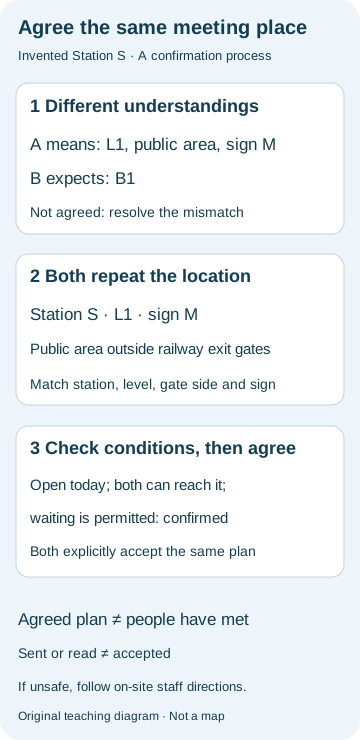
At station S, traveller A first sends, “Meet beside marker M in the L1 public area.” Person B misreads it as B1. Even though both remember marker M, the levels differ, so their status remains not aligned.
After correction, each person repeats: station S / level L1 / public area outside the railway exit gates / beside marker M. In this invented example, they have also confirmed that the point is open that day, both can reach it and waiting is permitted. They now have the same agreed plan. That does not mean they have met or guarantee that the real route remains open. A does not go back against the exit flow to reach an old point; B does not enter a railway restricted area.
5. Handle an exit change or lost contact
Both people must agree on a fallback before departure. Choose one primary point, one safe public fallback and a trigger for waiting or moving. Follow the same order so one person does not begin searching while the other simultaneously moves in the opposite direction.
If the point becomes unsuitable because of closure, crowds, restrictions or staff directions, follow safety and current instructions. At a new safe public position, use the original channel to state location, time and next action. Do not go against controlled passenger flow; do not cross vehicle lanes outside designated pedestrian routes or block escalators, gates or emergency access.
If contact fails, follow the pre-agreed sequence unless the location is unsafe or staff direct you to move; do not invent a place or post tickets, documents or contacts publicly. Store a private offline travel kit card on both devices: station, date, local time, primary point, fallback, waiting status and the location of staffed help. It cannot confirm current access conditions. For danger, medical need or emergency, contact on-site staff and local emergency services. Do not assume that a particular contact method will work or that help will arrive within a set time.
6. Copy the meeting card before departure
- Full station, arrival date and station-local scheduled time: ___
- Current train status and last check: ___
- Traveller's exit direction, luggage and mobility conditions: ___
- Route of the person meeting the traveller; legal parking/pickup arrangement if driving: ___
- Primary point—level, gate side, public area and marker: ___
- Source and time confirming open, reachable and permitted for waiting: ___
- Each person's restatement / exact match: ___ / ___
- Safe public fallback / movement trigger: ___ / ___
- Lost-contact order: original channel / agreed wait or move / staffed desk: ___
- Status: agreed / one person arrived / met: ___
- Privacy: no identity document, QR code, full ticket number or public phone: ___
Both official pages were rechecked on 26 September 2026 Beijing time (25 September UTC). This guide does not provide real-time train, access or parking information, or a nationwide pickup standard. Its workflow, script and invented example are original HeTuZhi editorial tools, not a guarantee that a route remains open or a meeting succeeds.