
High-speed rail suits weekends, family breaks and multi-province routes, but a two-hour train ride does not put a traveller at a museum two hours after leaving home. At Shanghai Hongqiao Railway Station, security, long internal walks, waiting, the city connection and luggage storage all consume time. Build a Suzhou or Nanjing itinerary around the exact stations and a safe return margin before adding sights.
When high-speed rail is the right choice
Rail is strongest for Nanjing, Suzhou or another destination whose station has good local transport and whose main sights occupy a compact area. Beijing can fit that pattern too, while a trip centred on Huangshan, Wuyi Mountain or Mount Emei still needs a separate bus, shuttle or hired-car plan after the train.
Compare the full China Railway journey, not the advertised running time. A short sector can lose its advantage when the home lies far from the departure hub and the hotel lies far from the arrival station. At Beijing South Railway Station or Guangzhou South Railway Station, older relatives, young children, a wheelchair or large cases make a direct service at a useful hour worth more than a cheaper cross-city connection.
Tickets, identification and changes
Use the official China Railway 12306 website or app for the train, date, class and current rules. A third-party package sold beside a China Railway booking does not create official priority. Names and document details must match the valid original travel document, and passengers using passports, Hong Kong, Macao or Taiwan documents, or a foreign permanent-resident card should complete the verification route shown by 12306 and leave time for staffed handling where self-service is unavailable.
China Railway wait-list bookings, ticket changes, destination changes and refunds depend on availability, timing and the terms attached to the order. Read the current China Railway 12306 terms instead of applying an old trip's fee or deadline. Separate China Railway bookings may split seats; child fares, student concessions, key-passenger assistance and cross-border services each need their own official check.
The China Railway 12306 order shows the exact departure and arrival stations; copy those names into the hotel and attraction routing before paying for either.
On Sale, Wait-Listed or Ticketed?
Use the official 12306 release-time lookup for the relevant release date and actual departure station. Do not assume every station releases tickets at midnight; follow any updated station notice or booking-page instruction. Not yet on sale, sold out and wait-listed are different states.
- Not yet on sale: check the date and station, prepare passenger details and set a reminder. A reminder or third-party advance-order confirmation is not an issued ticket in 12306.
- Wait-list payment made: the 12306 wait-list guidance distinguishes a prepayment from a fulfilled, paid ticket. Check the order outcome; payment alone does not establish a seat.
- Ticket issued: check the train, both stations, passengers and class, then plan the day around that train's scheduled arrival date and time, rather than the service you originally hoped to take. On the travel day, recheck its operating status using information from 12306, the station or onboard announcements and displays.
Choose a wait-list deadline that still lets you reach the station. The latest time offered by the system is not a suggested time to leave home. The official guidance allows changes to the deadline or cancellation of the request; deal with active requests when your plan changes. If no ticket has been issued, decide whether to change dates, use workable alternative transport or cancel the trip before lodging or activity cancellation deadlines pass.
If you need to change the train, travel date, class or passenger, first open the current 12306 order and check whether it is still awaiting fulfilment or has already produced a ticket. The 12306 wait-list guidance says that, once a wait-list order is active, only its fulfilment deadline can be changed. To change any other requirement, end the existing request and submit a new one. If a paid ticket has already been generated, follow that ticket's current change and refund instructions rather than treating it as an active wait-list request. After securing another workable ticket, verify it, then check the original request: end it through the current order if it is still awaiting fulfilment, or use the issued ticket's change and refund instructions if it has already produced a ticket. Do not assume that resubmission keeps the original order's place or that a prepayment return is immediate. The official page was checked on 26 September 2026.
Use the Golden Week booking sequence to connect transport and lodging deadlines. For a timed visit after arrival, also use the museum admission checklist so that a successful rail booking does not still leave you late for entry.
Check the station, not just the city
East, South, North and West are operational station names, not rough directions. Put the departure station, arrival station, hotel and first timed attraction on one current map before paying. A transfer between stations in the same city includes exiting, local transport, another security check and a new wait—it is not an in-station connection.
The examples make the trade-off visible. Beijing South Railway Station and Tianjin West Railway Station have mature urban links; Shanghai Hongqiao Railway Station shares a wider hub with Hongqiao Airport but still requires onward travel to central Shanghai. Suzhou Railway Station sits closer to the old city than Suzhou North Railway Station, while Hangzhou East Railway Station and Nanjing South Railway Station are major hubs rather than attraction entrances.
The same test applies farther south and west. Guangzhou South Railway Station, Shenzhen North Railway Station and Zhuhai Railway Station meet different city layouts; Chengdu East Railway Station, Chongqing North Railway Station, Kunming South Railway Station and Guiyang North Railway Station all need comparison with the actual room. Huangshan North Railway Station, Wuyishan North Railway Station, Leshan Railway Station and Emeishan Railway Station are gateways whose onward coaches, tourist shuttles, cableways and last departures must be researched separately.
A station-area room can help with a very early train; a late arrival needs staffed check-in and a legitimate pickup route. On the return day, avoid an attraction that cannot be left early. Luggage collection, urban congestion and the boarding cutoff all belong inside the margin.
Planning a rail connection, one leg at a time
If a direct service does not fit, compare connections in 12306. A combination appearing in the search results is not a guarantee that every traveller can make it. The official 12306 connection guidance asks passengers to consider transfer risks and allow sufficient time. The following is a planning method, not an official minimum connection time.
- Write down full station names and dates. List each leg's departure station, arrival station, times and travel date. Compare the first arrival station with the next departure station exactly. For an overnight journey, calculate across the dates rather than subtracting clock times alone.
- Separate same-station from cross-city changes. Even at one station, check the route from the arrival platform to the next boarding gate, whether a transfer channel is available and whether you must exit and re-enter. Follow station instructions. Between different stations, include the exit walk, waiting for local transport, the complete journey, security and the walk to the next gate; a map's driving time covers only part of that chain.
- Work backwards from the boarding cutoff. Subtract the transfer process and a buffer for delays, queues and navigation, then compare the result with the first train's scheduled arrival. Check the cutoff for the relevant station or service rather than assuming a universal number of minutes before departure. Families, first-time visitors and people with limited mobility should favour fewer changes and a wider margin.
- Confirm every ticket and an alternative. Check that each leg is ticketed for the correct passenger, stations and date; a fulfilled wait-list request for one leg does not secure the whole journey. Before paying, read each ticket's change and refund terms and consider a later service, an overnight stop or a different destination if the connection fails. Do not rely on the final connection of the day as the only option.
Sketch the route as “origin → station A / station B → destination”. If A and B differ, budget for a station change. Compare arrival time, number of changes, local transfers and recovery options alongside fare and train running time. For two or more changes, test every connection; if a leg leaves too little room, reduce the changes or split the trip over two days rather than making the whole itinerary depend on punctual arrivals.
If a delay or cancellation threatens a connection, ask station staff or 12306 how to handle the particular orders. The official guidance describes refund arrangements for connections disrupted by railway-related causes. It does not guarantee a seat on a chosen replacement service, and you should not assume the same conditions cover going to the wrong station or being delayed in cross-city traffic. Guidance checked on 21 September 2026; recheck the terms shown when booking.
Overnight connections: compare dated times, not clock faces
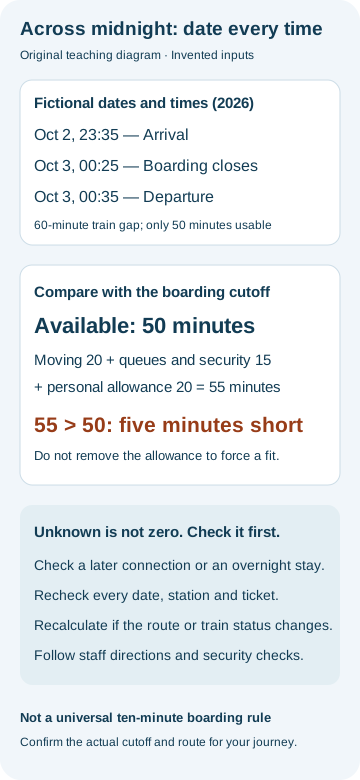
Write each leg as full date + station name + local time. Then verify the next leg's boarding cutoff through 12306, the specific train information or staff at the station. List steps that cannot happen at the same time: leaving the train and moving, any exit, security and queue, finding the gate, and a personal margin suitable for the traveller and party. Mark an unknown as pending, never zero minutes.
Invented example: the first train is scheduled to arrive at the same station at 23:35 on 2 October 2026, but this example requires leaving and re-entering. The next leg departs at 00:35 on 3 October, and its cutoff is assumed to have been verified as 00:25. The gap from the first arrival to the next departure is 60 minutes, but only 50 minutes are available before the cutoff. Movement takes 20 minutes, the queue and security take 15, and the traveller keeps a 20-minute personal margin: 20 + 15 + 20 = 55 minutes. The plan is five minutes short and is not workable. Do not delete the margin to force it to fit. Check a later connection or an overnight stay, including actual ticket availability and order status for that alternative. If tickets are unavailable or have not been issued, the fallback is not confirmed.
Every cutoff, movement time, queue and margin above is a teaching assumption. It is not a universal “ten minutes before departure” rule, a recommended minimum connection or a real train. After midnight, verify each ticket against that leg's actual departure date. In this example the second leg must not be booked for 2 October. Do not extend an assumption about an origin station or the first leg's date to a later leg. Recalculate if the train, station, route through the station, cutoff or delay status changes. Never chase a train, walk against controlled passenger flow or bypass security.
Copyable check card:
- First leg: arrival date, time and full station name: ___
- Next leg: departure date, time and full station name: ___
- Verified boarding cutoff and source: ___
- Non-overlapping steps and each duration: ___
- Personal margin / total required / usable window: ___ / ___ / ___
- Passenger, date and ticket status for every leg: ___
- Pending facts / later or overnight fallback and its availability/order: ___
Keep this card privately with the day-by-day itinerary and an offline travel kit, while remembering that an offline copy does not refresh train status. The 12306 connection guidance asks travellers to consider connection risks and allow reasonable time. The page showed no publication date and was checked on 25 September 2026. It does not provide this invented example or guarantee a connection, availability, change or refund.
Station time, luggage and accessibility
At Shanghai Hongqiao, Guangzhou South and other large hubs, the walk from metro platform to waiting area can be substantial. A first visit, public holiday, pushchair or heavy case justifies more station time. Keep documents, medication, charging equipment and valuables with the passenger, and keep cases or pushchairs clear of aisles. If something may have been left on a train or at a railway station, use the rail lost-property tutorial to record the last location, verify a similar listing or register and track a no-match report before confirming collection.
Liquids, sprays, alcohol, tools, camping equipment, batteries and oversized baggage are governed by China Railway's current prohibited, restricted and consignment rules. Use 12306 or a station's official channel rather than a short-video packing list. Travellers who need a wheelchair, guidance or boarding assistance should consult the current 12306 key-passenger service, establish eligibility, application route, meeting point and scope, and make a separate request for each leg when required.
Before packing, use the train luggage checklist to check bag dimensions and weight, power-bank markings and toiletry categories, then decide whether to reduce the load, change bags or arrange separate transport.
For an overnight sleeper journey, use the sleeper-train checklist to verify the traveller's carriage, berth and full arrival date, then separate a night-access pouch from the main luggage. A personal alert triggers a live recheck after waking; it does not replace announcements, displays or staff information on the actual train, and every bag still needs to be safely retrieved before leaving.
Before getting off, match every bag to its recorded location
These three steps apply to ordinary mainland-China rail journeys. They are an editorial check, not a railway rule setting one number of minutes before arrival. Use your ticket, the train's announcements and displays, and staff directions to identify your stop. Never block an aisle or inconvenience other passengers while checking luggage.
- Make a one-line record after boarding: list each item with a private label and its last location, including the main case, backpack and any shopping bag added during the trip. Keep identity documents, your phone and essential medication under your control. A recorded location does not reserve luggage space, and bags must not be staged in an aisle or doorway for arrival.
- Update the record after using anything: return an item to its recorded place or mark its new location to confirm. Do not count only the large case and forget a smaller bag near the seat. Do not climb or try to move a heavy item unsafely; ask train staff when you cannot check or retrieve it safely.
- Recheck after receiving the reminder for your stop: from a safe place that does not obstruct the aisle, verify that each item is yours; a similar colour is not enough. Mark it ready to take off the train only when you have safely retrieved it and can carry it with you. Seeing it on the rack does not count. Leave in the normal flow without rushing the doors. If an item is missing or you cannot retrieve it safely, tell train staff and explain its location. Do not chase the train, walk against controlled passenger flow or re-enter a restricted area. Once off the train, use the rail lost-property guide to search, register and follow up.
Invented example: after boarding, a traveller records three items—a blue case in the large-luggage area, a black backpack on the rack and a beige tote kept with them. A charging cable taken from the backpack during the trip is returned. After the reminder for this stop, ownership is checked and all three items are safely retrieved, so the status can be written as 3/3 ready to take off the train. If only two are ready, record 2/3; black backpack not ready and ask staff for help. Do not mark the list complete merely to hurry off. Colours are teaching labels only; the locations are not storage instructions for every train layout. Follow the actual facilities and staff directions. No real train, seat or universal checking time is represented.
Total items ___: ___ at ___; ___ at ___; item used during journey ___ returned / to confirm; ownership checked and ready to take off the train ___ / ___; last known location of an item not ready ___; help requested from ___ .
For this addition, the 12306 pages on carry-on belongings and onboard safety were read on 26 September 2026 Beijing time. The first says passengers are responsible for their belongings and must place them without affecting shared space or safety. The second says bags should be closed and stable and advises passengers to follow onboard announcements. Neither page displays a publication date. The item record, status labels and example above are HeTuZhi editorial tools, not an official guarantee or a substitute for staff directions.
Four useful trip structures
One city for a weekend
Choose a station with a direct city connection. In Nanjing, use the first afternoon for a flexible riverside or neighbourhood walk and the second morning for the principal museum or historic venue. Before the return train, stay in an area where the visit can be shortened.
Two neighbouring cities
A useful pair has a direct service that covers the intended travel window; do not assume a route has frequent departures until the current booking results show them. Stay in the first city, finish its last priority the next morning, then move; do not attach an inflexible performance to the first evening after arrival. Suzhou–Shanghai and Guangzhou–Shenzhen demonstrate the structure, but the actual stations and currently bookable trains decide whether it works.
Several cities on one corridor
With three or more stops, use one or two bases instead of sleeping one night in every city. A rail day trip from a fixed base avoids checking out and changing hotels, but still requires time for travel to and from the station, station entry, both train journeys and any luggage storage actually used. When changing bases, allow additional time for checkout, moving luggage and becoming familiar with local transport at the new base. Keep only the side trips whose final train leaves a realistic buffer.
Rail plus a scenic area
Treat Huangshan, Wuyi Mountain and Mount Emei as chains: station to room, room to visitor entrance, entrance to internal transport or cableway. A weather suspension, difficult luggage transfer or missed last shuttle can matter more than the intercity ticket.
One day or one night?
For a same-day return, favour a direct morning service and visit the most time-sensitive place first. The afternoon belongs to a park, waterfront or neighbourhood that can be abandoned without loss. A Suzhou night view is never worth missing the last practical train.
For one night, leave bags with the hotel or a legitimate storage provider after arrival. After checkout, store them again, complete the reserved visit and return to the station. Check opening and collection hours at the chosen Suzhou, Nanjing or Guangzhou facility, and keep identity documents and valuables with you.
Where to stay
- Near the station: useful for early departures, late arrivals, families and heavy luggage. A “Nanjing South station branch” may still require a vehicle, and the district may offer little evening food.
- In the centre: better for several days and evening walking, but the return to the station takes longer. Trace the walking route to the actual Shanghai or Chengdu metro entrance, not the listing's straight-line distance.
- Near the scenic area: practical around Huangshan, Wuyi Mountain or Mount Emei only after the last bus, reserved shuttle, luggage arrangements and cancellation are clear.
- Between two stations: when the arrival and departure hubs differ, a room on a direct metro line between them can prevent daily cross-city travel.
Older travellers, children and international visitors
For older travellers, include lifts, toilets, waiting seats, regular meals and medication time. A commuter's fastest change at Beijing South Railway Station is not a sensible family standard. Ask China Railway 12306 about assistance where needed, without assuming that it provides personal medical care or identical facilities at every station.
Families should carry a modest amount of familiar food, tissues and spare clothing, and establish child-ticket, pushchair and seating arrangements before travel. Several late trains in succession are rarely a useful school-holiday plan. Children remain with a named adult through security, boarding and station changes.
International visitors should use the current 12306 process for their exact identity document and carry the original used for booking. If online verification or an automatic gate is unavailable, the itinerary needs time for a staffed counter. Travellers who require an invoice should check the current 12306 and tax-authority instructions for the exact ticket type, travel date and identity document before purchase; old guidance about paper vouchers, electronic invoices, exceptions or issuance deadlines may not apply to this journey. Travellers managing diabetes, serious allergy or another dietary need should carry suitable food within railway rules and keep necessary medication accessible rather than relying on the train menu.
Child rail tickets: age on the travel date, then seating
Checked on 10 September 2026 against the 12306 child-passenger rules and English FAQ. This summary covers ordinary domestic real-name rail travel; check separate rules for Guangzhou–Shenzhen–Hong Kong cross-border services.
- Under 6, without a separate seat: One eligible child per ticketed adult may travel free; declare the child in advance.
- Under 6, needing a separate seat or exceeding the adult's free-child allowance: Buy a child-discount ticket for that child.
- From the sixth birthday until the day before the fourteenth: Buy a child-discount ticket.
- From the fourteenth birthday: Buy a full-price ticket.
Use age on each travel date, not the booking date: a sixth birthday between the outward and return trips means checking both legs separately. Book a child-discount ticket with the child's own valid identity document. A child travelling free also needs the child's document used for the declaration, not just the adult's ID. The child-discount ticket must match the adult's date, train and class and cannot end farther along the route. Matching class does not guarantee neighbouring seats; check the issued seat numbers.
These are railway categories, not attraction or airline rules. A child-discount ticket is not necessarily half-price in every class.
If someone is meeting your train, use the station meeting guide to agree the exact station, level, public area and permitted waiting point. Have both people repeat the details, and agree what to do if the exit changes or you lose contact; a map pin alone may not identify the same place.
Common planning failures
- Reading the China Railway arrival time as the start time of a Palace Museum, Nanjing Museum or garden reservation.
- Booking Suzhou North Railway Station when the route was built around Suzhou Railway Station, or treating a cross-city transfer as a platform change.
- Reaching Shanghai Hongqiao or Guangzhou South late without checking the last metro, legitimate taxi pickup and hotel reception.
- Placing a museum, mountain walk or river crossing immediately before the return train.
- Buying a train-and-hotel package without learning which company controls the ticket, room, invoice, refund and customer support.
Final check before departure
On the day before travel, open China Railway 12306 and confirm the train, station, passenger document and order status. On a current map, trace the station entrance and the complete onward route; then refresh weather, attraction booking and hotel instructions. If heavy rain, a typhoon, snow, strong wind or a railway adjustment disrupts the plan, protect the core transport and room first and remove optional sights. High-speed rail works best as an orderly, adaptable backbone—not as a timetable filled to the minute.