Travel laundry requires more than starting a machine. Check item suitability, drying scope, return time and whether one dry outfit remains. This guide recommends no provider, machine or product and gives no universal settings.
Use the high-speed train packing checklist to limit clothes and toiletries. Add only confirmed laundry costs to the budget travel guide, never an old online price.
1. Screen each garment by its own care label
Sort clothes into understood and compatible, professional care required, and uncertain groups. Record washing and drying limits per item; similar-looking fabrics may differ. GINETEX’s consumer article recommends following care information and professional cleaning when the brand recommends it. This article does not reproduce its pictograms.
For a missing or unclear label, or an item too important to risk, ask its manufacturer or a professional instead of test-washing it. Keep at least one dry outfit for the next wear; the laundry batch cannot also be the only backup.
2. Find out what “laundry” actually means
A hotel’s “laundry” listing may mean send-out service rather than guest-operated machines. Before handover or payment, confirm:
- send-out or self-service, and who loads, transfers and returns items;
- wash only or wash and dry, plus their expected condition at collection;
- accepted garments, labelling conditions and how the quantity is recorded;
- operating hours, last intake or last start, expected finish and committed return time;
- whether a queue is possible and when its length can be known;
- charging unit, required extras, payment point and the process if it cannot be completed.
Copy this question script:
I have ___ items with these care-label limits: ___. Is this send-out or self-service, and does it include drying? What is the last intake or start, the committed collection time, and the expected dry or damp condition? Is there a queue now? How is the total charged? If return before ___ cannot be confirmed, please do not accept the order.
“About one hour” does not replace confirmed intake, drying and collection. Decline send-out service whose return promise exceeds your deadline.
3. Create a count record before handover or start
Count by category. Record date, provider, pieces, a non-sensitive description, restrictions, charge, committed time and receipt location. Never post a room number or full order identifier publicly. For self-service, record the machine or area, start, stages and check time; do not leave laundry unattended for long.
At collection, check count, visible damage, dampness, items left inside and the final charge against the record. A finished cycle does not prove garments are dry or packable. If something is missing, damp or wrong, stop packing, contact the provider and retain the record; no dispute outcome is promised.
4. Work backwards from the ready-in-hand deadline
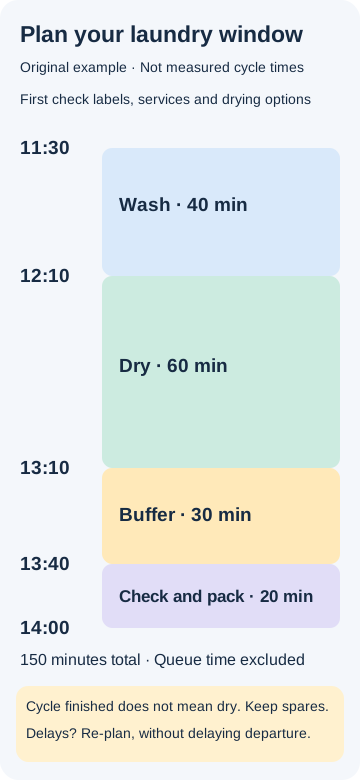
This fictional feasibility example is not a machine or business duration. Clothes must be ready in hand by 14:00. Allow 20 minutes to check and pack, a 30-minute buffer, and confirmed estimates of 40 minutes to wash and 60 to dry.
The planned total is 20 + 30 + 40 + 60 = 150 minutes, so the latest planned start is 11:30. The sequence is 11:30 wash, 12:10 dry, 13:10 buffer, 13:40 check and pack, and 14:00 ready. Queue time is not included. If the queue remains unknown, 11:30 is not a safe start.
The figures only test whether known stages fit; clothes may remain damp and rework is unknown. Before handover or start, an uncertain queue, machine state or rework margin means defer the batch. After handover or start, follow posted instructions and contact staff to arrange safe stopping, collection or return. Do not interrupt a running machine or force its door; follow posted instructions or staff guidance, and do not assume immediate retrieval. Keep the dry outfit; do not take time from checkout, luggage collection or return transport.
5. For self-service, follow three sets of instructions
Follow the garment label, machine instructions and detergent label together. Use only an identified, permitted product. Never mix cleaners or improvise with heat, duration or treatment. This article gives no temperature, spin, dose, disinfection or medical claim because garments, machines and products differ.
Check pockets and small items, then understand the lock, payment and finish alert. Stop after an error, leak, unusual smell, overheating or unclear instruction and contact the manager. Never use a hair dryer, heater or improvised heat source, or hang clothes from fire equipment, lights or prohibited fixtures.
6. Keep a plan that works without washing this batch
Keep three fallbacks: wear the dry outfit; temporarily bag dry, unwashed clothes and handle them by their labels promptly at the next reliable setup; or reduce the batch to confirmed items. Do not keep damp clothes sealed for long. Before handover or start, uncertainty triggers a fallback, not a smaller departure margin.
Final checklist:
- Every garment’s relevant care limits are understood; uncertain items are not test-washed.
- Send-out or self-service, wash-only or drying included, is confirmed.
- Last intake, last start, expected finish and committed return are recorded.
- Charge, item count and collection record are saved; clothes are not abandoned.
- The plan states whether a queue is included; an unknown queue is not zero.
- A dry outfit for the next wear remains available.
- Feasibility is decided before handover or start; an impossible deadline means do not begin. Collection still leaves time to check and pack.
- A delay changes the laundry plan, not checkout or return transport.
Source checked on 25 September 2026. The timeline, script and checklist are original HeTuZhi editorial methods. Confirm the actual service, price and garment conditions.