A collection of saved places is not yet an itinerary. This tutorial uses a three-day city trip with one hotel base to show how to group stops, handle reservations, budget time and remove activities when a day is too full. The result is a schedule you can check and change, not a checklist you must finish.
Use it once you have chosen a destination and have arrival and departure details plus some possible stops. For destination ideas, see the weekend travel guide; for choosing a base, use the hotel-location tutorial. This method is not a complete plan for altitude acclimatisation, mountain expeditions, island ferries or border crossings. Those require separate safety, transport and specialist checks.
1. Set the boundaries before filling three days
Write down the exact arrival and departure points, dates and times, your hotel address, and your companions' meal, rest and accessibility needs. Three days and two nights rarely mean three full sightseeing days. Leaving a station, reaching your base and dealing with luggage take time, as do the tasks before departure.
- Arrival day starts where and when you can actually begin an activity, not at the train's scheduled arrival time.
- Use the full middle day for a main area, with meals, rest and room for delays.
- On departure day, work backwards from luggage collection and onward transport before adding any optional activity.
Choose each day's available window around the people travelling. Nine hours is not a target everyone should meet. The 09:00–18:00 window below is an invented exercise: breakfast is before leaving and dinner after returning. If you need a midday hotel break, add both extra journeys and the rest itself.
2. Give every saved place a set of conditions
Make one record per stop. A blank field means something needs checking, not that it is unrestricted.
On narrow screens, scroll the table sideways to read all columns.
| Field | What to record |
|---|---|
| Place and entrance | Full name and actual visitor entrance, not just the building's map pin |
| Date and times | Opening day, reserved entry window, last admission and closing time separately |
| Confirmation | Confirmed booking, not yet booked, or no reservation required but opening still to check |
| Time needed | Door-to-door travel, entrance queue, visit, meals and rest |
| Priority | Main reason for the trip, convenient option, or something you can drop |
| Exit conditions | When to leave, what to cut if delayed, and when weather or closure means cancelling |
An entry slot, last admission and the end of a visit are different constraints. The National Museum of China's official visitor page treats booking slots, admission checks and seasonal opening arrangements separately. It illustrates the fields to check, not rules to apply to every museum. Read the notice and booking confirmation that apply to your date; ask the venue if information conflicts.
Do not mark an unconfirmed museum visit as booked. You can hold a conditional space in the plan, but decide on an alternative before relevant hotel, transport or activity cancellation deadlines. The alternative may need its own reservation. The National Day guide's booking timetable helps organise those decisions; its holiday calendar applies only to the stated year.
3. Group places by real journeys, then fit the bookings
Put the actual entrances on a map and check routes between them. A river, wall, station exit, interchange or slope can make two nearby pins awkward to connect. Use route estimates for the relevant weekday and roughly the time of day you plan to travel. Note whether walking, waiting and transfers are already included so you neither omit nor count them twice.
Temporarily group stops that connect reasonably within a day, then test the group against confirmed bookings, opening days and your companions' needs. If two neighbouring museums are available only on different dates, split the group. Grouping is a planning aid, not a guarantee of the shortest route.
An invented three-day outline might be:
- Arrival day: deal with the transfer and luggage, then keep only a short optional activity near your base. A late arrival can mean going straight to rest.
- Full day: anchor the plan on a confirmed main visit, with a nearby neighbourhood and meal. Calculate the details as shown below.
- Departure day: establish when you must leave your final activity, then decide whether a nearby visit fits. Do not cross the city just to complete the list.
If you change hotels, add packing, checkout, transport, storage and check-in. The journey between the two addresses is not the whole cost of moving. For money as well as time, see the budget travel guide.
4. Work the numbers: why this day does not fit
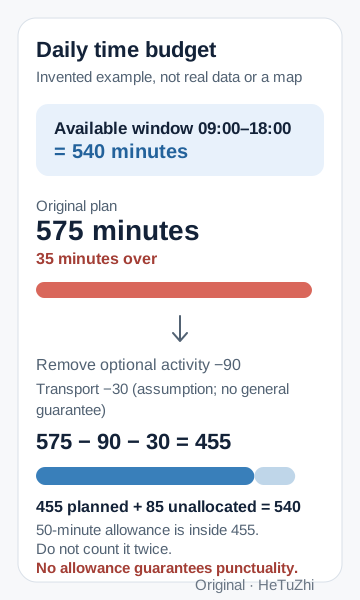
Every number below is invented for teaching. None is a real city's travel forecast, venue schedule or recommended visit length. Assume you leave your hotel at 09:00 and return to the same hotel by 18:00: 540 minutes. There is no midday hotel return. Transport includes leaving and returning to the hotel; its door-to-door estimates already include transport waiting. Entrance queues are separate. Activities, lunch and rest do not overlap.
On narrow screens, scroll the table sideways to read all columns.
| Time category | Original list | After cutting a stop |
|---|---|---|
| All travel | 120 minutes | 90 minutes |
| Visits and activities | 300 minutes | 210 minutes |
| Lunch | 60 minutes | 60 minutes |
| Separate rest | 45 minutes | 45 minutes |
| Queues and delay allowance | 50 minutes | 50 minutes |
| Total | 575 minutes | 455 minutes |
The original list exceeds the window by 35 minutes. Do not make it fit by skipping food, cutting necessary rest or assuming everything will run on time. In this example, drop an optional distant activity lasting 90 minutes, then recalculate the remaining journeys. Assume the revised travel total falls from 120 to 90 minutes. That 30-minute saving is an input to this fictional example, not an automatic benefit of removing any attraction.
The calculation is 575 − 90 − 30 = 455 minutes. Subtracting that from 540 leaves 85 unallocated minutes. The 50-minute queue and delay allowance is already inside the 455: do not subtract it twice. Nor must you fill the remaining 85 minutes with another attraction. They can mean more rest, slower walking or an earlier return. No allowance guarantees protection against a major delay.
5. Check the time slots, not just the total
A day can fit in total and still miss a reservation. Expand the same revised example:
On narrow screens, scroll the table sideways to read all columns.
| Time | Task | Minutes |
|---|---|---|
| 09:00–09:20 | Hotel to visitor entrance | 20 |
| 09:20–09:40 | Entry checks and queue allowance | 20 |
| 09:40–11:40 | Main museum visit | 120 |
| 11:40–11:55 | Travel to lunch | 15 |
| 11:55–12:55 | Lunch | 60 |
| 12:55–13:10 | Travel to nearby neighbourhood | 15 |
| 13:10–14:40 | Neighbourhood activity | 90 |
| 14:40–15:25 | Separate rest | 45 |
| 15:25–16:05 | Return to hotel | 40 |
| 16:05–16:35 | Additional allowance if delays have not occurred | 30 |
| 16:35–18:00 | Unallocated time | 85 |
This assumes a valid booking and opening arrangements allowing museum entry at 09:40 and departure at 11:40, plus a lunch venue open at the relevant time. If those conditions fail, change the plan. The example is not a reservation. The 20 minutes at the entrance and 30 minutes at the end total the 50-minute allowance. Showing some allowance at the end is bookkeeping: delays can happen anywhere, and spare afternoon time does not prove that a morning booking is reachable.
Check each connection: previous activity end + next journey + necessary entry preparation must fit the permitted slot. If the morning is already 40 minutes late, first check whether admission is still possible, then cut or cancel as needed. The 85 minutes later in the day cannot make a missed morning slot valid. Follow the operator's rules for a missed slot.
6. Work backwards for departure and write down what to cut
Start with the carrier's and terminal's applicable check-in or entry requirements. Work backwards through relevant terminal walking and security, luggage collection, the complete journey to the departure point and uncertainty allowance. That gives you the time to leave the final activity. Do not just subtract a navigation estimate from the ticket's departure time. Airports, railway stations and ferry terminals do not share one universal advance-arrival allowance. See the rail travel guide for rail connections.
Write the cutting order into the schedule. First remove unconfirmed or lower-priority distant options and recalculate travel. Then shorten activities only where that is feasible. If bookings, necessary rest or departure still cannot be met, cancel more activities or change transport or accommodation. Check cancellation terms separately rather than assuming an abandoned booking is refundable.
Weather or safety restrictions are not solved automatically by choosing an indoor venue. The Ministry of Culture and Tourism's 23 September 2026 travel reminder calls for checks on weather and transport along the route, as well as opening and reservation arrangements. Consider an alternative only when its venue, access routes and local safety instructions permit it. If instructed to shelter, remain in place or evacuate, follow those instructions rather than completing the itinerary.
7. Copy this daily planning sheet
- Date; starting place and time; required finishing place and time:
- Companions' essential meal, rest, access and mobility needs:
- Main visit; actual entrance; booking status; entry slot; last admission:
- Nearby optional stops and the first activity to remove:
- Each journey's mode, estimate source, time checked and unresolved details:
- Visit minutes + travel + meals + rest + queues and allowance:
- Total; available window; excess or unallocated minutes:
- Luggage collection place and deadline; time to leave the final activity:
- Cancellation or rerouting triggers; checked alternative; booking change and cancellation deadlines:
- When to recheck notices, reservations, routes and weather before departure:
Finish with three questions: does each day have a real usable window, can every fixed booking be reached step by step, and do you know what to remove if delayed? The worksheet and invented calculations are editorial planning tools, not an official route or a fitness standard. Official pages were consulted on 24 September 2026; check the notices applying to your trip again before travelling.