A route number alone is not enough. It may run in opposite directions, terminate early, branch, skip stops or loop; stops with the same name may be on different sides of the road. This guide checks one journey, not live routes or a nationwide sign system. Use itinerary planning for fixed points and the step-free route guide for a wheelchair, pushchair or other mobility aid.
1. Write the journey from actual door to actual door
Record the actual entrance at both ends, full date, travel window, party, bags and limits on walking, steps, transfers or waiting. Split the chain: origin door → safe pedestrian route → exact stop → bus → destination stop → safe pedestrian route → destination entrance.
A map icon does not establish the boarding position. Confirm the road, traffic direction, side of the road, junction and a public landmark. Use designated pedestrian crossings; do not cut across traffic, climb barriers or enter bus operating areas. If you cannot find the stop, remain in a safe pedestrian area and contact the operator or ask staff.
Write the expected time at the stop, not only the time an activity ends. Check whether your estimate includes walking, crossings, lifts and finding the stop. Add missing parts without counting included time twice. Mark missing facts UNKNOWN, never zero minutes or “probably fine”.
2. At the stop, check number, direction, stop order and terminus
Use this order: route number → direction → destination appears after this stop → this vehicle's terminus or branch. Do not ask only whether it is “route X”. Locate the current stop on the posted or current operator information, read forward in the direction of travel and find the destination later in the sequence. Then check the vehicle's terminus and stopping pattern so that a short working does not finish early, a branch does not diverge before your stop, and an express does not skip it.
An older Beijing Government English bus guide says signs may show routes, stop order and first/last-service information and points to bus websites or apps. Checked on 26 September 2026 Beijing time (25 September UTC), it supports checking sequence and operator information. Its old fares, route counts and hours are excluded; its sign description is not nationwide.
Do not guess which direction around a loop is quicker. Stops with the same name, stops served in only one direction and temporary stops need separate checks. Ask staff about the destination and terminus; speak to the driver only when the bus is stationary and it will not interfere with their duties.
3. Check today's service and the actual payment action
Check first and last service for the date, exact stop and direction. The last departure from the route origin is not the time it passes an intermediate stop. For evenings, holidays, works, controls or weather, use current operator notices. UNKNOWN does not mean the service is available.
A Beijing Government notice dated 19 March 2026, relaying a Beijing Public Transport announcement, recorded route and one-way stop changes from 26 March. It is historical evidence that directions and stop positions can change, not proof that its listed arrangements apply today.
Confirm accepted payment, charging basis, where the ticket is obtained, any boarding or alighting action, and how companions use it. Do not assume all cities require a boarding tap, both taps or one method. Ask the operator about price, eligibility, network need or procedure; never invent a fare or mark unusable payment confirmed.
4. Invented stop chain: one route number, different outcomes
This one-way teaching chain is not a map or to scale and has no real route, place, fare or time:
A → B → C → D → E
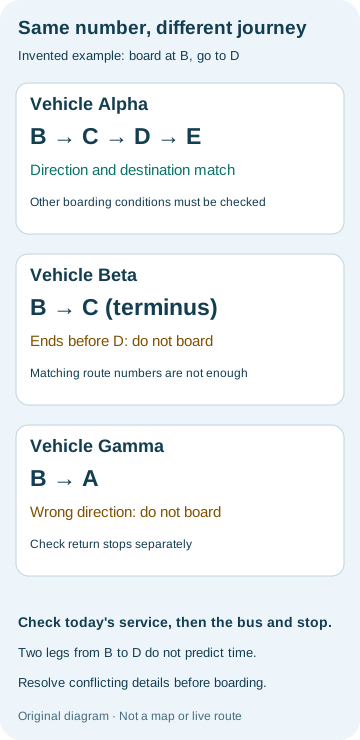
At B, a traveller wants D and sees three vehicles bearing the same fictional route number:
- Vehicle Alpha terminates at E and currently lists C, D and E after B. It is only a candidate. Choose it only after today's operation, actual stopping pattern, payment, party, bags and access conditions are also confirmed.
- Vehicle Beta terminates at C. It does not reach D, so do not board merely because the number matches.
- Vehicle Gamma shows B→A. It runs in the wrong direction, so do not board.
B to D contains two links: B→C and C→D. Stop count cannot predict minutes. Check real branches, short workings, expresses, skipped stops and loops against the vehicle's stops and terminus.
5. Recheck on board, then plan the return
After boarding, use displays, announcements or operator information to confirm the next stop and destination sequence. Secure bags and prepare to alight as instructed without crowding doors, obstructing the driver or pushing while moving.
For a wrong direction, branch or missed stop, never ask the driver to let you off between stops or anywhere stopping is not permitted. Alight only when stationary at a permitted stop, move to a safe pedestrian place, then seek help and replan. “The next stop” is not guaranteed suitable; current conditions and instructions come first.
Check the return independently. A position across the road may not be the return stop. Route, direction, branch, service window, payment action and terminus can differ. Night, rural, reservation-based and temporary services need their own current rules rather than ordinary daytime assumptions. If the bus option remains unclear, stay somewhere safe while checking available rail transport or a licensed transfer, including waiting, walking and access requirements. Change the activity if you cannot confirm a workable journey; do not compensate by rushing.
6. Copyable city-bus action card
- Date, travel window, party, bags and essential access conditions: ___
- Safe pedestrian chain from origin door to exact stop: ___
- Stop position—road side, direction, junction or public landmark: ___
- Route / vehicle terminus or branch / stops listed after here: ___ / ___ / ___
- Destination definitely appears later / every
UNKNOWN: ___ / ___ - Today's service at this stop and direction; time checked: ___
- Payment method, charging basis, boarding/alighting actions, companions: ___
- On-board next-stop and destination recheck: ___
- Safe help route after a wrong bus or missed stop: ___
- Return stop, direction, terminus, service and payment checked separately: ___
- Confirmed fallback if unavailable: ___
Keep the card privately in an offline travel kit, but an offline record does not prove that service, stops or roads remain unchanged. Both official pages were checked on 26 September 2026 Beijing time (25 September UTC). The remaining steps are editorial checks, not a substitute for the operator's current rules or a guarantee that a bus suits every traveller.