Driving into a city does not require taking the car to every attraction. Compare destination parking, park-and-ride (P+R) and hotel parking for the same date, car, party, start, finish and outing window. “Available” does not reserve a space, and a map price cannot replace current terms.
Use the road-trip guide for driving boundaries and the hotel-location guide for the real door and route. This tutorial recommends no car park, payment product or live route.
1. Fix the inputs before comparing prices
For every option, record one date, party, vehicle, hotel door, first and final destination, departure, collection deadline and legal vehicle eligibility. Name the garage entrance, not a district.
- A — destination: check its entrance, final walk and return collection.
- B — P+R: count public transport by person and trip.
- C — hotel: confirm that day’s incremental parking and count transport for everyone.
If party size, entrance, vehicle eligibility or a necessary charge is unknown, mark the option HOLD. Never insert zero to make it rankable.
2. A discount has conditions, while a space still needs rechecking
A 2025 Beijing Government P+R example required a matching transit card or code, transit use during parking, the same entry/exit credential, and compliance with time and overnight conditions. It is not a national rule; its old price and window are not reused.
Copy this question script:
I plan to enter on ___ at ___ and collect the car before ___. The vehicle is ___ and ___ people will transfer to ___. Please confirm the actual vehicle entrance, today’s opening, discount credential and transit-record requirements, whether entry and exit need the same credential, treatment of re-entry or overnight parking, the ordinary charging rule if the discount fails, the final collection or exit time, and the nearest legal alternative if full. Does an available-space display show only the current moment?
Eligibility does not reserve a space. Confirm a legal fallback, its charge and connection. Never turn a gate queue into stopping in a fire lane, restricted kerb or doorway.
3. Calculate the outing, not one parking number
Use one formula:
Incremental outing total = parking + incremental driving + public transport by person and trip + confirmed mandatory extras.
Check the parking billing unit, rounding, cap, overnight treatment, re-entry and ordinary price after discount failure. Multiply transit fares by people and journeys. Count driving items only when they differ; do not repeat fixed vehicle costs shared by all three.
A Beijing market-regulation parking-price page supports checking the posted price and related service and charging information. Its body is dated 15 December 2023 despite the 2024 URL. It supplies no legal conclusion or tariff elsewhere. Billing unit, rounding, cap, overnight treatment and re-entry are this tutorial’s checklist items, not a list attributed to that page.
Write UNKNOWN, not zero, for an unconfirmed ordinary rate, cap or extra. Keep parking, transit and hotel records for the exit check.
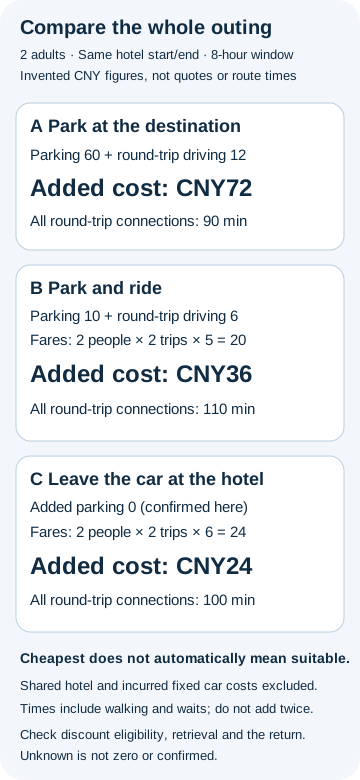
4. Put the whole outing cost in one table
This is a fictional CNY example, not a real city, garage, hotel, fare or quote. Two adults share one car, use the same hotel start and finish on the same day, and compare one eight-hour outing window.
On narrow screens, scroll the table sideways to read all columns. Keyboard users can focus the table and use the arrow keys.
| Option | Parking | Incremental driving | Public transport | Outing total | Fictional full outward/return travel and parking-collection links |
|---|---|---|---|---|---|
| A Destination | CNY 60 | CNY 12 | CNY 0 | CNY 72 | 90 min |
| B P+R | CNY 10, eligibility confirmed | CNY 6 | 2 people × outward and return × CNY 5 = CNY 20 | CNY 36 | 110 min |
| C Hotel | CNY 0; hotel confirms the car may remain for all 8 hours | CNY 0 | 2 people × outward and return × CNY 6 = CNY 24 | CNY 24 | 100 min |
The shared room and fixed vehicle costs are excluded. The 90, 110 and 100 minutes cover all outward and return travel plus parking and collection links, including this example’s walking, waiting and transfers. They exclude sightseeing and meals and are not the whole eight-hour activity duration. B uses CNY 10 only because eligibility is confirmed; if it fails and the ordinary rate is unknown, B cannot be ranked. C is zero only because the hotel confirms the car may remain for all eight hours with no extra charge that day.
C is cheapest here but is not automatically recommended. Unsuitable transit, a missed connection, collection deadline, need for the car or unsafe driving state can change the choice. Cost and time never guarantee availability or safety.
5. Protect both the collection deadline and the return connection
Every option has two time constraints: final collection/exit and transport from the last activity back to the car. Running transit does not prove the garage is open, or vice versa. Confirm both.
Before leaving, recheck the return, entrance, wait and collection buffer. If delay threatens either condition, leave earlier or use a confirmed fallback. Never recover time through illegal stopping, speeding or fatigue. Stop and rearrange when driving is unsafe.
6. Exit rules for a full lot, failed discount or changed entrance
- Full on arrival: go to the prechecked legal alternative; do not block the entrance while waiting for a space.
- Eligibility or ordinary rate unconfirmed before entry: do not choose the discount option or enter and gamble on the exit bill.
- Discount not recognised at collection: after parking and completing the transit record, contact staff or customer service through the on-site process to check eligibility, charge and evidence. Keep parking and transit records; do not evade payment, force an exit or assume a refund.
- Entrance or exit changed: stop only in a safe legal place and ask the operator. Do not follow navigation into a pedestrian, closed or internal road.
- Return connection disrupted: if an activity is still under way, shorten or cancel it and use a confirmed alternative connection. If you are already on your way back and cannot meet the collection deadline, do not rush or take risks. Contact the parking operator or hotel to confirm whether late or next-day collection is possible, how access would work and what it would cost. Do not assume acceptance, free storage or a refund; keep unconfirmed arrangements marked as unknown.
Photograph the level, zone, bay and exit. Keep records private. Never publish the full registration, position, room, order number or receipt QR code. Check the charge; no refund or dispute outcome is promised.
7. Copyable comparison template
- Shared inputs: date___; people___; same car___; same start/finish___; outing window___; vehicle eligibility___.
- A Destination: actual entrance___; parking rule and total___; incremental driving___; walk/connection___; collection deadline___; full-lot alternative___.
- B P+R: entrance___; eligibility and credential___; ordinary rate if it fails___; people × return transit___; transfer route and time___; collection deadline___; full-lot alternative___.
- C Hotel: incremental parking that day___; hotel confirmer and time___; people × return transit___; final access___; fallback___.
- Shared costs excluded from the difference:___.
UNKNOWNitems and next check time:___.- Pre-departure recheck: vacancy as a live snapshot only, entrance, price, transit, collection and legal fallback.
- Stop conditions: eligibility fails with ordinary rate unknown; no legal space; return cannot meet collection; driver state unsafe.
Both historical Beijing sources were checked on 25 September 2026. The formula, template and fictional example are original HeTuZhi editorial methods, not live parking information or prices.