The lowest nightly rate in a hotel list may not describe the same product. Dates, occupancy, bed type, breakfast, cancellation terms and mandatory charges can differ. A useful comparison aligns the offers first, then calculates the confirmed cost of the entire stay. This tutorial recommends no property and uses no real market quote.
If you have not settled the area and door-to-door journeys, start with the hotel-location tutorial. Use the budget-travel guide to put lodging back into the whole trip with transport, meals and an emergency reserve. This page deals only with comparing bookable accommodation offers on one basis.
1. Fix the comparison basis before sorting
Write one line of requirements before opening the candidates:
- check-in and checkout dates, number of nights and local time;
- adults, children, any required child ages, room count and occupancy;
- essential bed type, capacity and other non-negotiable stay conditions;
- how many breakfasts are needed, for how many people and days;
- acceptable payment method and payment timing;
- one acceptable cancellation deadline, charge basis and no-show treatment.
Offer A's cancellable king room and offer B's non-refundable twin room are not directly comparable merely because both cover two nights. First find offers that meet the same essential room and occupancy requirements and the same cancellation basis. If that is impossible, mark them “not equivalent” instead of declaring the smaller number cheaper.
2. Copy a line-by-line comparison sheet
Give each candidate a column. Write “unconfirmed” for an unknown amount, never zero:
Basis: <check-in/out> | <guests/rooms> | <essential bed and stay conditions> | <same cancellation basis>

Line | Offer A | Offer B
Full room name and occupancy | |
Sum of each night's room charge (rate × nights only if rates match) | |
Breakfast: people × days × unit price, or “included” | |
Taxes/service charges included? | |
Other confirmed mandatory charges | |
Certain discount usable now | |
Confirmed whole-stay cost | |
Refundable deposit, separate from cost | |
Payment timing and currency | |
Cancellation deadline, charges and no-show terms | |
Unconfirmed item and verification channel | |
Add each night's room charge separately; multiply a rate by the number of nights only when every night costs the same. Do not apply the first night's price to a weekend, holiday or room change. “Breakfast included” still needs a guest and day count. Whether taxes or charges are included must come from the current order page. Parking, an extra bed or a transfer enters the cost only when your trip requires it and the price is confirmed. Leaving an amount unconfirmed prevents a false zero from winning the comparison.
3. Calculate the whole stay; separate deposits and uncertain discounts
Use one formula:
Confirmed whole-stay cost = all nightly room charges + confirmed mandatory charges + necessary add-ons − certain discounts usable now.
Do not add breakfast or taxes twice when already included. Do not subtract an unclaimed coupon, possible cashback or a member rate that requires an unpriced membership. If a new membership fee is necessary for this booking, list that cost separately. Record a deposit with its payment and return conditions, but do not count it as confirmed accommodation spending, assume when it will be returned or released, or infer the account balance from it. Update the table only if a deduction later becomes confirmed.
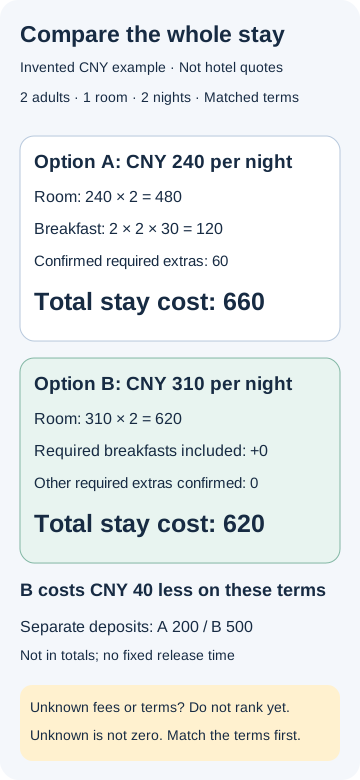
4. Worked example: compare the same two-night stay
Every figure below is an invented CNY amount, not a quote for any city or property. Two adults share one room for two nights. Both offers meet the same essential bed and stay conditions, and the same cancellation terms have been checked.
On narrow screens, scroll the table sideways to read all columns. Keyboard users can focus the table and use the arrow keys.
| Line | Offer A | Offer B |
|---|---|---|
| Room | CNY 240 × 2 = 480 | CNY 310 × 2 = 620 |
| Breakfast | 2 people × 2 days × CNY 30 = 120 | Included for both people on both days; CNY 0 extra |
| Other confirmed mandatory charge | CNY 60, expressly excluded and required | Confirmed none; CNY 0 |
| Confirmed whole-stay cost | CNY 660 | CNY 620 |
| Refundable deposit, separate | CNY 200 | CNY 500 |
A has the lower nightly rate, yet its confirmed cost is CNY 40 higher. B's zeroes do not hide unknowns: breakfast is included and the absence of other mandatory charges has been confirmed. Deposits show a potential difference in funds tied up; they do not enter CNY 660 or CNY 620. Verify whether and when each deposit is charged or authorised and released; this example makes no timing assumption.
The example supports only this conclusion: with these requirements and terms confirmed as equal, B costs CNY 40 less for the stay. If B's bed, cancellation, payment timing or another condition is unsuitable, the lower number does not make B an unconditional recommendation.
5. Use one confirmation script before payment
The Daxing'anling market regulator's online hotel-booking reminder advises reading the room description, price and cancellation policy, saving the booking page, and confirming with the hotel after booking. This tutorial uses only those preparation steps. It does not extend the notice's legal language or promise a refund in a dispute.
Ask the platform or property through a trusted channel:
I plan to book
<full room name>from<check-in>to<checkout>for<guest count>. Please confirm the total room charge, how many guests and mornings breakfast covers, whether taxes or service charges are included, every other mandatory charge, the deposit and its conditions, payment timing, cancellation deadline and cancellation charges. Can these details appear on the booking confirmation?
Save the page, channel and confirmation time. Do not post a full order number, payment code, one-time code or identity-document image in a public group. If a verbal reply conflicts with the order page, pause until the difference is clarified through a trusted channel and reflected in the order.
Back-to-back hotel bookings: map each stay night
This method covers one group of guests that needs one room each night and uses two bookings for one stretch of accommodation. Draw separate night lines for multiple rooms or different guest groups. Adjacent dates at the same hotel do not mean that the hotel has linked or merged the bookings into one continuous stay. Nor do they establish the same room, breakfast, cancellation terms or check-in procedure. Check the night-by-night coverage first, then confirm the transition arrangement.
- Copy each booking separately. Record the property's full name and address, check-in and checkout dates, room and occupancy, confirmed benefits, booking status and its own cancellation terms. Do not carry breakfast, bed type or confirmation from booking A into booking B. Mark an unknown as pending, never zero.
- Map every stay night to a booking. Using the booking pages and the hotel's confirmation, label each local date on which a room is needed with its booking reference. A blank is a gap. If two bookings appear on one night, mark it pending: they may duplicate this one-room line, or one may belong to another room or guest group. Do not call it an overlap until the inputs are checked. If it is duplicate coverage for this group and room, do not cancel either booking on the assumption that cancellation will be free.
- After checking coverage, confirm the transition arrangement and the actual result. Through a verified private channel, give the hotel both bookings and ask whether they are linked, whether the guests may remain in the same room, and whether they must check in again, return or replace keys, change rooms or wait between rooms. Ask whether any confirmed benefit changes or an added charge applies. Record the transition arrangement as awaiting reply / confirmed, then record execution at the hotel as not started / partly completed, with the outstanding item named / completed. A confirmed arrangement remains a plan; it does not show that the room handover, key change or room move has been completed. Linked bookings do not by themselves promise the same room or uninterrupted room access. If a room move is required, use the hotel room-check guide to track belongings and key cards separately.
Invented example: one guest group needs one room per night at the same property. Booking A checks in on 2 October 2026 and checks out on 4 October. In this example, its page and the hotel confirm that it covers the nights of 2 and 3 October. Booking B checks in on 4 October and checks out on 5 October, covering the night of 4 October. The three required nights have no date gap, but that proves only the coverage in this example, not a continuous stay in one room. Before the hotel replies, the transition arrangement is awaiting reply and execution is not started. Even after the hotel confirms a plan, execution must be updated at the property. If repeat registration is complete but the confirmed room handover, key change or room move is still outstanding, record partly completed and name the outstanding item. If B instead checks in on 5 October and checks out on 6 October, the night of 4 October is uncovered. A checkout dated 4 October does not provide a room for that night.
Private copyable card: property/address __ | guest group __ | rooms needed each night __ | A: check-in __ checkout __ stay nights __ room/benefits __ status __ cancellation __ | B: check-in __ checkout __ stay nights __ room/benefits __ status __ cancellation __ | each night: date __ = A/B/gap/two bookings pending check | bookings linked __ (not proof of one room) | transition arrangement: awaiting reply/confirmed __ | same room/move, key or repeat check-in, wait, added charge __ | execution: not started/partly completed/completed __ | outstanding item __ | hotel reply and time __. Do not put full booking references, identity documents or key-card details in a public group.
A Daxing'anling market-regulator hotel-booking reminder published on 21 January 2025 advises travellers to read the room description, price and cancellation policy, save the booking page, and confirm room information with the hotel before and after booking. The author consulted this page on 26 September 2026. It does not say that adjacent bookings must be linked or merged, retain one room or avoid another check-in. The nightly coverage map and status card are editorial checking tools.
6. Stop the booking in these situations
- Dates, guests, room count, bed type or eligibility remain unconfirmed.
- The page shows only the first night or a “from” rate, not the two-night amount due.
- A mandatory charge is unknown but has been entered as zero.
- Cancellation terms, deadline time zone or payment timing changes at the last step.
- The displayed price depends on an unpurchased membership, unclaimed coupon or future cashback.
- Someone asks for off-platform payment, an unfamiliar link or a one-time code.
- The final payment amount differs from the table and the difference cannot be explained.
Read the final page again before payment. Afterwards, check dates, room, occupancy, breakfast, amount, cancellation terms and booking status, then confirm with the property as the official reminder suggests. If confirmation fails, the booking remains unconfirmed or the terms change, do not submit repeated payments. Check the original channel and payment record first. This guide supplies a comparison method and reasons to pause; it does not allocate liability or guarantee cancellation, refund or deposit outcomes.
7. Sort only the offers that remain comparable
Sort by confirmed whole-stay cost only when every necessary field is known and the columns are genuinely equivalent. Keep “CNY 40 lower”, “smaller deposit” and “later payment” as separate observations, so you can decide which matters. Combining unlike numbers into one score hides the trade-off. Refresh the page and save the evidence before booking; after dates or occupancy change, rebuild the sheet instead of reusing the old total.
The table, formula and example are original HeTuZhi editorial tools. The official consumer reminder was published on 21 January 2025 and consulted on 25 September 2026. Actual prices, room types, benefits and terms must be checked on the valid page and through the confirmation available before payment.