After reaching a booked property, use this guide to check whether the room matches the confirmed booking and to report ordinary-use problems privately. Use the hotel-location guide to choose an area and the hotel rate-comparison guide before payment. This is not a safety certification.
For immediate danger such as smoke or fire, exposed wiring, severe incoming water or forced entry, do not remain for photographs or a complaint checklist. Put personal safety first and seek help or take protective action according to conditions and local emergency directions. This guide does not teach electrical inspection, alarm testing, climbing, hidden-camera detection or detailed fire escape.
1. Prepare the confirmed booking facts
Keep a private note of the property name and address, stay dates, confirmed room and bed type, occupancy, breakfasts and included essential facilities. Separate entitlements from requests: “twin beds confirmed” differs from “high floor requested where possible”.
Do not include the key card, booking reference, identity document or guest names in public photographs, reviews or groups. Supply necessary information only through a verified hotel or original booking channel, and do not publish the room number with the itinerary.
Arriving early: separate the request, luggage and next update
Reaching the hotel early proves only that the traveller is at the property. It does not confirm early access to the room. If the room has not been handed over, record the request, any luggage handover and the next update as separate states; “being prepared” does not complete all three.
- Record the request status: provide only the booking information needed for check-in, then repeat the hotel's local stay date, confirmed room type and occupancy. Ask whether check-in can be completed now and whether any charge or condition applies. Record the reply as requested / agreed, with the arrangement recorded / unavailable now / awaiting reply. A preference, an online early-check-in button or “we will see” is not room access.
- Treat luggage storage as another handover: ask whether this property offers storage before check-in, whether it will accept these bags and their contents, what it costs, and how collection works. Check the bag count, receipt and storage point at the handover. Keep identity documents, wallet, essential medication and valuables under the traveller's control. If the hotel has not accepted the bags, do not leave them in a lobby corner or unattended. After a confirmed handover, the bag-count, receipt and collector fields in the luggage-storage guide can help, but its post-checkout timing example does not apply here.
- Agree the next update instead of guessing a ready time: confirm who will contact whom, through which channel, when the traveller should ask again, whether the waiting area is available for use, and what counts as room handover. A room-number preview, cleaning message or “nearly ready” remains pending. Mark the room handed over only when the hotel follows its process, provides the usable key or access method and confirms entry to the assigned room. If a companion needs rest or the waiting plan fails, verify an available public waiting area; if alternative accommodation or transport is needed, confirm its conditions and cost first. Do not assume that the original booking can be cancelled free of charge.
Invented example: the booking lists a regular check-in time of 15:00. The traveller arrives at 11:20 after requesting early check-in, but reception says the room is not ready. In this example, the hotel actually accepts two bags at 11:30, provides receipt R, and agrees that the traveller will ask reception again at 14:30. Record early check-in awaiting arrangement / room not handed over / 2 of 2 bags accepted / recheck at 14:30. At 14:30, “still being prepared” does not change the room state. It becomes room handed over only after the traveller receives a usable access method for the assigned room and the hotel confirms that it may be used to enter that room. These times, receipt R and the property are all fictional; they do not establish a universal check-in rule or readiness guarantee.
Property and stay date ___ | early arrival ___ | early check-in: requested / agreed / unavailable / awaiting reply ___ | added charge or condition ___ | bags accepted ___ / ___, receipt and storage point ___ | essentials kept with traveller ___ | waiting place ___ | who updates whom and how ___ | next check ___ | room not handed over / actually handed over ___.
The official Park Hyatt Shenzhen FAQ, read on 26 September 2026 UTC, describes early check-in as subject to room availability and hotel policy and lists pre-check-in luggage storage separately. It supports only the distinction between a request, room handover and a separate bag handover. One property's page does not promise free storage, a fixed room-ready time or the same arrangement elsewhere.
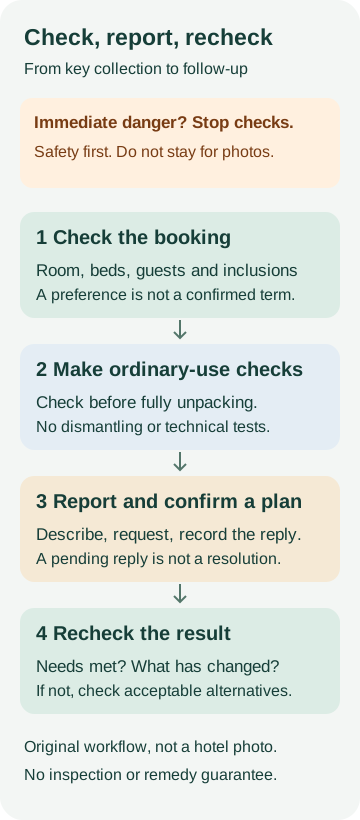
2. Check the room before unpacking
Keep valuables secure and avoid fully unpacking until the basic match is clear. This makes a move easier. Whether or not you have unpacked, describe the specific problem and ask for a response; unpacking alone does not establish the outcome.
Use one short sequence: booking facts → ordinary-use check → private report and confirmed plan → recheck. Do not pull apart a bed, move heavy furniture, open equipment covers or touch fire-safety devices.
A Qiaokou District market-regulator notice published on 28 October 2024 mentions checking facilities and chargeable-item prices, keeping records and communicating first. It is preparation advice, not a nationwide standard or a guarantee of any remedy.
3. Stay within normal use
First compare the room or bed type, occupancy, breakfasts and included facilities with the booking. Look for a visible current stain, damage or obviously unprepared bedding; do not dismantle mattresses, frames or fabric layers.
Check ordinary controls once: whether locks close, switches control the lights, a tap runs and shuts off, and panels for confirmed facilities respond. A closing lock is an observation, not proof of a security grade. If something jams, leaks, sounds unusual or will not respond, stop. Do not repair it or touch wiring, breaker boxes or internal parts.
Note the direction of marked evacuation routes and exits. A Ministry of Emergency Management notice dated 30 April 2024, republished by the Chinese government portal, advises noticing them on entering places including hotels. Checked on 25 September 2026, it supports only this arrival reminder—not a claim about current risk or a substitute for signs and staff directions.
4. Record facts and make a clear private request
Record what, when, where and after which normal action: “At 21:10, the confirmed twin room had one large bed.” Photograph only relevant detail and context, excluding people, identity documents, booking codes and key-card information. Never remain in danger for a photograph.
Copy this script:
My booking confirms ___ for ___ guests. In the room I can see / during normal use I found ___ at ___. I am requesting ___. Please confirm who will handle it and when I should expect a definite reply. If the original arrangement cannot be provided, please state the options, any change to confirmed benefits and any extra charge. Mark anything not agreed as pending.
A request for an equivalent room or repair is not a hotel promise. Repeat back a specific action and reply time and retain the original-channel record. “We will look into it” remains pending.
5. Recheck a changed arrangement
For a move, confirm the new bed type, occupancy, breakfasts, other original entitlements and any extra charge. Repeat the short check in the new room. For a repair, confirm who is attending, the expected time and whether the room is suitable while waiting. Reporting is not resolution, and travellers should not repair equipment themselves.
Invented example: a booking confirms twin beds for two people and two breakfasts, but the room has one large bed. The travellers have not fully unpacked. They privately show necessary booking details and request an equivalent confirmed room type. While reception checks, the status is “reported; plan pending”. It changes only when bed type, breakfasts, timing and charges are stated and the actual arrangement is rechecked. No real hotel, room number or price is represented.
If no room is available, repair fails or a companion needs rest, ask for a waiting place, next update and alternatives. Confirm any fallback's availability, address, access and cost while retaining original terms. Do not assume free cancellation, a move, refund or compensation. For shared payment, keep the final bill before using the shared-cost ledger; a pending adjustment is not a received refund.
Track belongings and key cards separately when changing rooms
Use this checklist only after the hotel has confirmed a room change and conditions allow normal packing. Ask reception when to collect the new key, when the old key must be returned or will stop working, whether you may return to the old room during the move, and whether assistance is available and whether it costs extra. Follow the agreed procedure. Do not assume that you can use both rooms, and never delay an urgent evacuation to collect belongings.
- Before leaving the old room: while you still have permission to enter and there is no danger, check the places you actually used: bedside, desk, wardrobe and bathroom. Look only where you can normally see and reach; do not move heavy furniture or dismantle equipment. Keep your identity documents, wallet and phone in a bag you control. Note the number of packed bags, and remember chargers, drying clothes and anything held by the hotel. Do not pack hotel property.
- During the move: agree who is carrying each bag, then check it yourself on arrival. An offer to help does not prove that everything has arrived. If several trips or temporary storage are needed, confirm the storage location, who is accepting the items, the receipt and the return arrangements. Do not assume an unattended corridor is a storage area. For a formal storage handover, use the luggage-storage guide.
- In the new room: alongside the booking and ordinary-use checks above, compare the list with where each item actually is: with you, in the new room, accepted for safekeeping by the hotel, or still unaccounted for. Counting suitcases alone can miss loose items. Deal with the old key as agreed and check that the new key works for the room assigned to you; a working key does not establish permission to enter a room.
Invented example: your phone is with you and your suitcase is in the new room, but you remember leaving a charger plugged in beside the old desk. Record the charger as awaiting retrieval, not the move as fully checked. Even if the old key still works, contact reception first to confirm access or staff assistance. If the key has been returned or disabled, or another guest occupies the room, do not follow someone inside or try the key yourself. On receiving an item, check its model or recognisable features. If it cannot be found, keep a note of the last known location, contact time and any reply still pending. Recovery or compensation is not guaranteed. No real hotel or room number is represented.
A short private note is enough: items with me ___ / bags in the new room ___ / items accepted by the hotel / receipt held ___ / items still to retrieve ___ / old-key handover status ___ / next contact and time ___. The old key may already be returned while an item remains outstanding: keep those states separate. Do not publish room numbers, key-card photographs or booking codes.
For this addition, the Qiaokou regulator's 2024 hotel notice was checked on 26 September 2026 Beijing time (25 September UTC). It advises guests to take all belongings when leaving and retain supporting records. The room-change checklist above is an editorial method, not an official universal key-return sequence, a right to re-enter the old room or a finding about hotel liability.
Once any room issue has been handled, the stay still needs a separate checkout closeout. Use the hotel checkout checklist to check belongings and return key cards safely, reconcile the itemised bill with payments already made, and record separate complete or pending statuses for cash deposits, actual charges and card pre-authorisations. Completed checkout does not mean that every deposit repayment, refund or pre-authorisation has reached its final recorded state.
6. Copyable arrival-check card
- Property, address and stay dates: ___
- Confirmed room/bed, occupancy, breakfasts and essential facilities: ___
- Requested but unconfirmed preferences: ___
- First entry time and difference from booking: ___
- Ordinary-use check—bedding, locks, lights, tap and confirmed facilities: ___
- If a danger sign requires help first, stop routine checks and follow conditions and emergency directions: ___ (this card does not certify room safety)
- Private record excludes people, IDs, booking codes and key-card details: yes/no
- Reporting channel, time and request: ___
- Confirmed action, reply time, changed benefits and extra charge: ___
- Result after action; matters still pending: ___ / ___
- Rest plan and confirmed fallback accommodation/transport: ___
Both official pages were checked on 25 September 2026. The sequence, script, status record and invented example are HeTuZhi editorial tools. They do not promise a move, repair, refund or compensation or replace on-site management and local emergency directions.