After handover terms are chosen, this guide covers observable condition, matching records and return status. Road trips and city parking are separate tasks. This is not vehicle selection, liability or insurance advice, or professional inspection.
For an immediate hazard, leave and contact staff. Do not remain for photographs or drive with an unresolved safety concern.
1. Bring the handover inputs together
Keep together: supplier; pickup/return place and time; vehicle; driver; base charge; deposit; mileage or energy terms; included items; late or one-way conditions. Mark each confirmed, pending or not applicable. Unknown is not zero; a pending deposit is not received.
A Beijing transport notice dated 26 November 2021 discusses matching plate and contract, joint inspection and a signed record, return details, and settlement. It is Beijing-specific historical guidance, not nationwide document requirements. Checked 25 September 2026.
Give required identity, plate and booking details privately through the authorised channel.
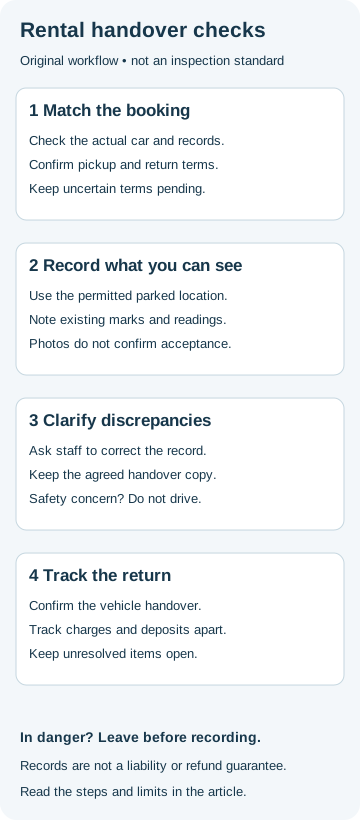
2. Check the handover while parked
While safely parked where allowed, match vehicle, order and form. Record visible existing scratches, dents or obvious glass/lamp-cover damage, plus mileage and energy shown by staff. Do not start the vehicle for this check, remove covers, look underneath, road-test or test brakes.
Check confirmed keys, cards or child seat; ask price and unit for chargeable items. Keep images private and exclude people and documents. A photograph alone does not determine liability or resolve a dispute.
If identity, condition or safety remains unclear, do not drive. Ask for inspection, a record update or another vehicle. If no acceptable solution is reached, check another established transport option; cancellation still does not guarantee a refund.
3. Make both records agree before signing
Describe location + observation + extent: “existing surface scratch on the right front wing”. Compare both records; ask staff to add omissions and timestamp them. A blank or “we know” is not a specific entry.
The vehicle listed in the order is ___; the vehicle presented here is ___. At ___ I can see ___, while the form says ___. Included items, mileage or energy are ___. Please update differences, then confirm pickup time, return place/time, base charge, deposit and pending charges.
This aligns records; it does not decide safety, liability or compensation. Keep a readable copy before signing.
4. Invented example: wrong vehicle and old scratch
An order shows fictional plate ending A, while the presented vehicle's plate ends B. The traveller asks whether this is an entry error or a replacement. Correct an entry error; for a replacement, recheck the confirmed type, price and terms, and update the record only after the traveller agrees. A changed record alone is not consent to drive away. A right-front scratch is also absent, so staff are asked to record its location and condition. Continue only when both differences are resolved and readable.
No real plate or supplier is represented. A photograph alone does not determine liability or resolve a dispute. Unconfirmed identity or safety means no driving: request inspection or alternative transport.
5. Separate completed and pending items at return
Return at the confirmed place/time with time for inspection. Recheck vehicle, visible condition, mileage or energy, keys and included items. Obtain a record of the actual return time and vehicle-acceptance status. Use unattended return only under a confirmed process; parking alone does not prove handover.
Changing the return branch during a rental: confirm more than a map pin
Use this section when you already have the car and want a different receiving branch, or when a notice tells you that the return location has changed. It helps identify which instructions apply to this booking. It does not determine the legal effect of a contract change or establish that a supplier must accept a change, waive a charge or provide transport. Read messages and contact the supplier only while safely parked where permitted, never while driving.
Keep the original confirmed branch, location, time and handover method. Use the original booking channel or another verified service channel to make a specific request: the booking and vehicle concerned, original branch A, proposed branch B, requested return time, and whether the included items will still be returned as originally listed. Provide necessary booking and vehicle identifiers privately; do not publish full plates, booking codes, identity documents or key details. A sender who signs an unfamiliar message as “staff” does not thereby verify the phone number, link or address in that message.
| Information you have | What it does not establish | What to check next |
|---|---|---|
| Your request to return at B has been sent | Acceptance of the change or arrangements for B to receive this vehicle | An explicit answer through the verified channel about this booking and its applicable conditions |
| A map pin for B, or a reply saying there is a nearby branch | B is the receiving location for this booking | Full branch name, vehicle entrance, permitted handover location and time |
| A notice names B while the order still names A | The records agree, or A necessarily remains applicable | Which instructions currently apply, where the answer is recorded and how the conflict has been resolved |
| The change is confirmed but the car has not been handed over | Inspection, final settlement or a returned deposit | Follow the confirmed handover, then track inspection, charges and any refund separately |
Bring four groups of answers into one readable private record. There is no universal document format in this checklist. Describe conflicting records rather than deciding for yourself which takes precedence.
- Booking and receiving location. Confirm that the answer concerns your booking and vehicle, the original and new branches, the receiving branch's full name and address, and the vehicle entrance and permitted handover position. A sign, shopping-centre name or general map pin does not identify the vehicle entrance.
- Time and handover steps. Recheck the applicable return date and local time, staffed acceptance or a confirmed unattended method, and the steps for keys, cards and other included items. A's key box, contact or operating arrangements do not automatically apply at B.
- Conditions and unanswered items. Ask the supplier to explain any charge items, amounts or charging units associated with this change, and whether mileage, energy or included-item terms change. Unanswered items remain pending, not zero. Do not infer a waived charge or guaranteed refund. Record the channel, reply time and readable order update or explanation; this record does not decide liability or whether a charge is lawful.
- Conflicts and follow-up. If the order, notice and receiving staff give different instructions, ask the supplier to coordinate through a verified channel: which instructions should you use now, where can you read the answer, and when should you contact them again? Until clarified, do not label B a confirmed receiving branch, leave the vehicle in a place you chose yourself to catch your next connection, or give keys to an unverified person. If there is no usable plan, continue checking available options with the supplier. Do not assume that you must return to A, proceed to B or have permission to return late.
An invented change-of-branch example: recheck bags and onward pickup
A, B, P and Q below are invented labels, not real branches, map positions, distances, times or services. The original order confirms return at A. The traveller asks to return at B and can find B on a map, but the reply only says “we are contacting the branch”. Record “request sent; change pending; supplier clarification needed on the currently applicable instructions”, not “B accepted”. Retain the original order as the original arrangement. Do not delete it or treat it as a newly reconfirmed answer while the conflict remains unresolved.
A new, explicit reply then confirms B for this booking and supplies its vehicle entrance, permitted handover position, return time, key and included-item acceptance steps, applicable conditions and follow-up channel. The supplier also explains why A still appears in the order and provides a readable record of the instructions that apply to this booking. After checking each answer, the traveller can mark the answered fields confirmed. That status comes from specific answers about this booking, not from waiting, changing navigation or finding a branch pin. Actual return, inspection, final charges and any refund are still outstanding. A missing necessary step remains pending; confirmation of another field does not fill the gap.
The change also affects onward pickup. The original pickup point P belongs to A; B's vehicle entrance is not P. A confirmed branch change does not establish that the original transport booking will collect everyone at B. Contact that transport provider privately to check whether the booking can be adjusted or another arrangement is needed. Separately confirm B's pedestrian exit, actual pickup point Q, booking status, capacity for all companions and bags, and the actual entrance at the next destination. Unconfirmed items stay pending. “Same brand”, “both near the airport” or “looks close on a map” is not a substitute. If the entrance is closed or the receiving location conflicts with the record, contact the supplier from a safe place where stopping is permitted and does not obstruct traffic. Do not sort bags or remain in a traffic lane to record the situation.
Use the road-trip guide to revise the journey to the confirmed return location. If the next journey is a flight, use the airport departure checklist separately for the terminal and airport procedures. An unknown departure arrangement, wait or handover duration is not zero. The original journey plan does not establish that the revised connection works. Do not speed, drive tired or skip handover steps to save time. This section rechecks inputs affected by the change; it supplies no actual service hours, estimated distance or universal buffer.
Copyable return-location change card: original arrangement A / proposed B / applicable receiving branch and record location___; change result and unresolved conflicts___; return date and local time, vehicle entrance and handover position___; key, card and included-item steps___; explained conditions and pending items___; confirmation channel and reply time___; outcome for old pickup booking P___; new pedestrian exit, pickup point Q, people, bags and booking status___; follow-up contact and agreed review___; separate actual handover, inspection, final-charge and deposit/refund status___.
This addition is Hetuzhi's editorial checking method and an invented status example. It adds no supplier policy or same-day operating claim. The historical official material checked on 25 September 2026 and its original scope remain unchanged. Those pages were not revisited for this batch; their evidence date has not been refreshed.
After-hours return: what remains after handing over the key?
For a one-way or after-hours return, first confirm whether the receiving branch offers an unattended process. Do not assume a key box is available. This editorial checklist is a way to organise the handover, not a policy shared by all suppliers:
- Confirm the method before setting off. Through the confirmed booking or branch channel, record the exact permitted parking location, entrance, method for returning keys and vehicle cards, and who will report inspection and charge status, through which channel and within what agreed window.
- Match the location on arrival. If the entrance is closed, the designated bay is unavailable, the key-box label differs or the instructions conflict with the confirmed record, do not improvise another return location or put the key in an unidentified box. Contact the branch from a safe place where stopping is permitted and does not obstruct traffic. Keep the handover pending. Do not remain in a hazardous position for photographs.
- Keep a private record of the confirmed steps. Where safe and permitted, record the parking location, time, visible vehicle condition, mileage and energy level already displayed, returned items and actual key handover. Do not start or operate the vehicle just to obtain a photograph. Keep any receipt actually provided by the platform or branch; otherwise record “receipt not obtained”. Do not publish full plates, booking codes or personal details, or photograph key teeth. Images help document the process; they do not determine liability.
- Close each status separately. After depositing the key or reporting the return in the platform, track the handover step, branch acceptance/inspection, final charges and deposit/refund separately. Check through the confirmed channel at the agreed time. Without a clear result, that item stays pending; returning a key does not mean everything is settled.
Invented status example: the key has been returned by the confirmed method, but the branch has not reported its inspection. Record “key returned; inspection pending; final charges pending”. Add the next contact and agreed review time to the last line of the handover card rather than guessing a universal settlement deadline.
A Xinjiang market-regulator notice dated 1 August 2024 recommends handover images, itemised-charge checks and final-amount confirmation. It does not set a universal deadline. Checked 25 September 2026.
Label money separately: base charge confirmed; new charge pending explanation; final amount confirmed; deposit pending return; refund received. Ask the supplier or original platform about unknown lines. Pending is not settled. Put shared final costs in the travel expense ledger, while pending items stay pending.
Plan the journey from the return branch to the departure entrance
An “airport branch” label does not establish that you return the car at your flight's departure entrance. After handing it back, you need transport for yourself, your companions and your bags. Confirm that journey before choosing the last sightseeing stop.
- Record two separate destinations. Confirm the receiving branch's full name, address, vehicle entrance, permitted return location and handover procedure. Separately record your flight's actual terminal and the area for your next airport procedure. A general airport map pin does not identify either entrance.
- Confirm how you will leave the branch. Check the pedestrian exit, pickup point, service hours, booking status, capacity for everyone and their bags, and the actual destination terminal. An unconfirmed branch shuttle stays unconfirmed. A service called a “shuttle” is not enough evidence that you can use it. Identify a usable backup and allow for waiting, moving bags and walking at the destination; availability is not guaranteed.
- Take everyone and their belongings with you. Remove your own bags and personal items while safely parked where permitted, account for your companions, then follow the agreed vehicle and key handover. Do not sort bags or take photographs in a traffic lane. Track physical handover, later inspection, final charges and the deposit separately. If the branch confirms that the required on-site steps are complete and later checks will be reported separately, retain the contact and follow-up plan before leaving. If the on-site requirements are unclear, contact the branch rather than omitting a step to catch a flight.
- Work back from your actual onward requirements. Use the airport departure checklist to check check-in, baggage, security and boarding separately. If return takes longer, reassess the connection: remove the last activity if still possible, or ask your transport provider or airline what changes are available. Do not speed, drive tired or skip the handover to save time. Changes, refunds and waived charges are not guaranteed.
If you want to store bags before another activity, use the luggage-storage checklist to confirm acceptance, collection hours and transport after collection. This does not establish that a return branch or airport offers storage. Keep a private note of on-site handover status; the inspection contact and review time; the pedestrian exit and pickup point; your terminal and personal airport target time; and backup transport. Do not publish booking codes, key details or full licence plate numbers.
Source limits: Beijing's rental guidance published on 26 November 2021 addresses returning at the agreed time and place. It is historical local guidance, not every operator's current contract. Capital Airport's landside shuttle page describes transport between terminals, not a connection from any rental branch. The airport page has no publication date. Both were read for this section on 4 October 2026; no service frequency, door number or same-day operation promise was adopted. The workflow above is Hetuzhi's editorial method.
6. Copyable pickup and return card
- Supplier, driver, pickup/return place and time: ___
- Order/presented vehicle; match: ___ / ___ / ___
- Visible condition, location and extent: ___
- Mileage, energy, included items: ___
- Base charge, deposit, terms, pending charges: ___
- Added notes and confirmation time: ___
- Safety concern/action; not driven if unresolved: ___
- Actual return time, vehicle-acceptance record, returned items: ___
- Final/pending/deposit/refund status: ___
- All pending items, next contact channel and review time: ___
Pages checked: 25 September 2026. This workflow is not mechanical diagnosis, liability allocation, insurance advice or a refund promise.