Two lines crossing on a diagram do not prove that an open passage connects their platforms without exiting. The same station name does not establish one concourse, paid area or operator network. This guide covers one task: moving from the arrival platform, choosing a verified in-station or exit-and-re-enter route, and reaching the correct direction on the next line. For bus stops and route numbers, use the city-bus guide. For continuous step-free access, check each segment with the step-free route guide.
1. Write the next-leg inputs before arrival
Do not write only “change to Line Y at J”. Record the city, full station, current Line X, next Line Y and direction. Describe the direction with both its terminal direction and the next station where possible, rather than relying on one terminal name that may change. Add the full date and time window, fare medium in use, party, bags, and any wheelchair, pushchair or other equipment conditions.
Place the transfer inside the day-by-day itinerary. The first train's arrival time is only its planned arrival at a platform. It is not arrival at the next platform and does not establish that the next line can still be boarded. Check that line's service at this transfer station and in this direction; leave an unknown as unknown.
2. Follow transfer signs before following an exit
After alighting, move clear of the doors and passenger flow before reading signs. Check in order: interchange line → direction → next station or terminal → platform. Do not follow a familiar exit number merely because it appears first. A station diagram, phone map or pair of crossing lines helps with orientation, but only current signs and staff can confirm that a passage is open and remains inside the relevant paid area.
At the next platform, verify Line Y, trains towards Q and the next station using platform information, train-direction displays or staff guidance. Adjacent platforms may run opposite ways; reaching Line Y is not enough. If crowds, barriers or temporary guidance differ from an old screenshot, stop following the old route. Do not walk against controlled flow, cross barriers or enter a closed passage.
3. Before exiting, confirm the fare-gate boundary
Some transfers require exit and re-entry, but travellers should not assume that this is equivalent to an in-station interchange. Before exiting, ask staff whether this is the current designated route, which exit and entrance to use, whether a time condition applies, whether security is repeated, how the fare medium is recognised, and whether the journey remains continuous or starts again. If any condition is unknown, do not assume that a discount, a single through fare or re-entry will be available.
A Shanghai Municipal Transportation Commission FAQ dated 7 July 2021 described out-of-station transfers as depending on conditions such as specified stations, fare media and time intervals. This local historical page supports only the need to check those conditions. It is not a live 2026 rule or a nationwide rule; this guide does not reuse its named stations, specific minutes, fares or fare-media exclusions. The page was checked on 26 September 2026 Beijing time (25 September UTC).
Use the fare medium as the current operator instructs. If continuous recognition requires the same medium, do not switch between phones or cards or use another person's travel credential. If staff confirm that the next leg is a separate journey requiring a new fare, follow their instructions on the supported ticket, transit QR code or other medium. Do not treat an ordinary payment QR code as a transit credential. Never follow someone through a gate or climb over it. For a gate exception, wait in a safe place that does not block passenger flow and ask staff. Repeatedly tapping in hope of fixing the issue may create another fare event.
4. Invented example: A is verified; B is not an equivalent shortcut
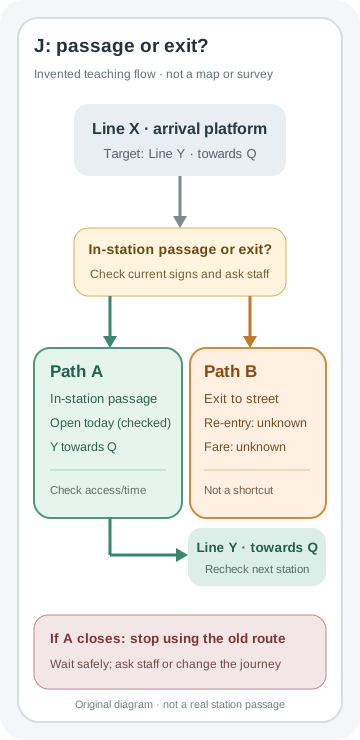
Station J, Lines X and Y, and destination Q are entirely fictional. They are not a real map, measured distance, fare or timetable.
A traveller alights from Line X at J and needs the Line Y platform for trains towards Q. Path A is an in-station interchange passage that staff have confirmed is open that day and reaches the Line Y platform for trains towards Q. It is therefore a candidate for this journey. It does not guarantee timely arrival, an empty route or suitability for every mobility aid. Wheelchairs and pushchairs need a separate check of lifts, gates and continuous access.
Path B exits to street level and enters again elsewhere. Its entrance, fare-medium recognition, security and fare conditions remain unknown. B is therefore pending. A shorter-looking phone-map line does not make it equivalent to A, and the traveller should not exit first and guess later.
If A closes, stop following the old diagram. Wait somewhere safe without obstructing movement and ask staff about another interchange, a different service or an itinerary change. Do not enter the closed passage or assume that B automatically becomes usable.
5. Handle changes and plan the return separately
If signs, platforms, passages or the next line change, restart from the current location, fare-gate side, Line Y towards Q and fare-medium status. After an accidental exit, do not follow another passenger or climb over a gate to return. Keep the current fare status, tell staff where and when the exit occurred and which direction is needed, then follow the current handling process. Do not assume that a fare adjustment or refund will be available.
Check the return independently. Trains towards Q will usually not serve the return journey, and the entrance to the passage, fare-gate boundary or lift can differ. Verify the return line, direction, next station, passage and last service. A scheduled arrival on the preceding train does not prove that the next line can be caught. If late-night availability remains uncertain, prepare a verified surface alternative rather than running, pushing or crossing facilities to catch a train.
6. Copyable transfer check card
- City, full transfer station, date and time window: ___
- Current line and arrival platform / next line: ___ / ___
- Next direction, terminal direction and immediate next station: ___
- Fare medium / party, bags and equipment conditions: ___
- Route type: in-station / exit required / pending: ___
- In-station route: current opening source, sign chain and target platform: ___
- If exiting: designated exit/entrance, time, security, fare medium and fare conditions: ___
- At the next platform—line / direction / next station: ___ / ___ / ___
- For an exception: current gate side, fare status and staff response: ___
- Next line's last service at this station and direction: ___
- Return line, direction, passage and last service checked separately: ___
- Verified fallback if the passage closes or remains uncertain: ___
The workflow, card and fictional J Station example are original HeTuZhi editorial tools, not an official transfer guarantee. Follow current operator information and on-site guidance for passages, fares, security, last services and equipment access.