If an item may have been left at a railway station or on a train, stop in a safe place. Do not chase a departed train or cross a gate, platform boundary or controlled area against instructions. If you are still on the train or inside the station, first tell on-site staff where the item was last seen. If you have left, organise the time and place, then use an official China Railway 12306 search or report route; you need not finish an online process before asking available staff for help.
This guide covers mainland China railway stations and trains. A city metro, bus, taxi, ride-hail, hotel or venue has a different operator and is outside this railway channel. Check cross-border rail separately. Use the high-speed rail guide for the journey and the train packing checklist to reduce loose items before departure.
1. Narrow down the last known place
Do not guess that the destination station must hold the item. Write the sequence:
- travel date, train, and the time range when possession was last confirmed;
- carriage and seat area, rack, washroom or door area, or a station’s security, waiting, gate or platform area;
- item category, colour, size, material, packaging and one or two distinctive verification points;
- the next possible location, such as a transfer or exit, clearly marked “uncertain”;
- a callback contact supplied privately only through a verified official channel.
Separate known, uncertain and next action. A companion may help remember, contact staff or record progress; account submissions and collection by another person must follow the operator's requirements for the traveller and companion. Before relying on a contact method, check whether an overseas number can be used and whether the required language support is available.
If a lost phone or travel document affects the current journey, entry or communication, explain the immediate travel problem to station staff or a 12306 staffed channel. This article does not expand into bank, account-security or legal steps; use each provider’s official process separately.
2. Search by train or station, then register
The 12306 lost-property search offers train or station and date searches: consult 12306 about a similar result, or register details and follow report progress when none matches. The service instructions say registered users may act for themselves and passengers, while others can register or use railway customer service, and should describe the loss location and item fully. Both pages had no visible publication date and were checked on 25 September 2026.
The 12306 mobile query displays station, train and date filters plus item number, found date and category. Use those fields to prepare a query; if the interface or process changes, ask an official staffed channel for the current route.
Use this order:
- If the train is known, search by train and actual travel date.
- If the item was probably lost at security, waiting or the platform, search the specific station and date.
- If both are possible, run both searches; one empty result is not every possible result.
- For a similar but incomplete result, ask the official channel to verify it. Do not declare ownership.
- If nothing matches and no report exists, file one and keep its record. If a report already exists, retain it and use the official route to add information or check progress rather than opening repeated reports for the same loss.
Never publish a full ticket number, identity-document number, verification code, callback number or all distinctive details. A public request should use only a broad category and date; give precise information privately to a verified official channel.
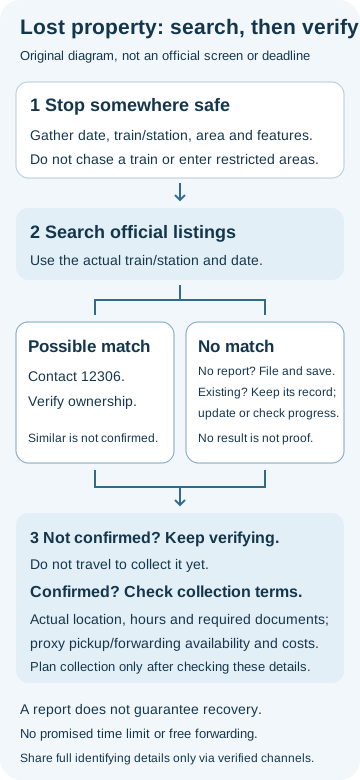
3. Choose the next step from the search result
Use three states rather than only “found/not found”.
Similar listing: verify before claiming
Record its item number, found date, category and query time. Tell the official channel the relevant train or station facts and keep private features ready for requested verification. Matching colour, brand or case alone does not establish ownership; do not travel to collect before a match is confirmed.
No current match: register and track
If no report exists, complete the official fields for the item and loss location, then save the submission time, record number or page status. If one already exists, retain that record and use the official route to add information or check progress rather than creating a duplicate. Schedule the next progress check. “No result in this search” means only that no match is currently displayed, not that the railway has concluded the item was never found.
Match confirmed: collection still needs confirmation
Ask for the actual holding location and desk, service window, owner-collection documents, whether proxy collection is supported and its materials, whether forwarding is possible, possible charges and the next contact. Mark every unknown as UNKNOWN. Do not assume forwarding is available or free, or rely on an unconfirmed storage period or delivery time. Never infer the holding station from the ticket destination.
4. Fictional record: known, uncertain and next action
This example has no real train, station, number or passenger.
Known
- Placeholder date:
YYYY-MM-DD; train:TRAIN_EXAMPLE. - Last seen from 13:20 to 13:45 near the example carriage seat.
- Item: blue soft pouch; the public note includes only category and colour.
- An official search shows one similar, unverified listing.
Uncertain
- Seat, rack or departure path as the exact loss point.
- Whether the listing belongs to the traveller; holding point, collection evidence, proxy, forwarding and charges.
Next action
- Give the train, date, location range and private identifiers through a verified 12306 channel for staff verification.
- Do not add the ticket, identity document, callback contact or all identifiers to a public message.
- If it does not match and no report exists, file one and save its record. If a report already exists, keep it and use the official route to add information or check progress.
5. Confirm collection or forwarding before travelling
Copy this script:
My report reference is ___ and the listed item number is ___, if available. Please confirm the current holding station and desk, service window and documents for owner collection. Is collection by another person allowed, and what documents or authorization are required? If I cannot attend, is forwarding available, through what process and with what possible charge? Please mark anything not yet established as pending rather than assuming it for me.
Before travelling to collect, contact the official channel again to confirm that the item is still held at that location and that the desk can handle collection at the planned time. A proxy should provide only the required materials. Never send a password, verification code or unnecessary identity information to a stranger. Consider forwarding only after support, destination, handover method and charge are confirmed; permission to forward does not mean free or immediate delivery.
Keep a separate status for each lost item
When more than one item may be missing, or you receive updates about only part of a loss, do not use one “found” label for everything. The 12306 lost-property query guidance, read on 4 October 2026 UTC, distinguishes consultation about a matching listing from registering details and following progress when none matches. The service instructions require a complete description of the location and items. Neither page displays a publication date. The item-by-item list below is an editorial method, not an official form, case-closure rule, storage period or recovery guarantee. It does not require a separate new report for every item.
Prepare the existing report reference, the last confirmed time and place for each item, private identifying features and the replies actually received. Then update the list in six steps:
- Give items private labels and retain their relationships. List a bag, a separately carried umbrella and a bottle on separate rows. List headphones or a cable inside the bag as its contents; one bag containing two items is not three bags. Knowing an item was inside at the time is different from assuming it was there out of habit. Mark the latter uncertain rather than inventing a last-seen time.
- Separate your labels from official references. A personal label such as R01 is not an official item number. Record which item an existing report, search listing or staff reply concerns. Use an officially permitted route to explain additional details and items still missing. Ask staff how to supplement the existing report or handle items separately; do not submit duplicates for the same incident or assume that several private rows mean several reports were submitted.
- Retain each row's original status and check time. Keep “similar listing to verify”, “match confirmed but not yet collected”, “physically received” and “contents still to check” distinct. Confirmation or collection of one item cannot fill in other rows. “The bag has been found” does not establish the status of an unconfirmed umbrella, bottle or small item inside it.
- Check what you actually receive. Where staff allow it and without obstructing the desk or movement, compare identifying features, quantities and visible condition of the bag and its contents. Leave an item marked unchecked if it has not been examined. If something differs or is not seen, report the observation alongside the original record; do not infer where the loss occurred, who was responsible or that theft occurred. Do not open another person's bag, unlock an unidentified device or include other people's identity documents in a photograph.
- Keep a next action for unfinished matters. Ask a verified official channel how items not found, not collected or inconsistent with the contents list should be linked to the original record, supplemented or followed up. Retain the earlier reply, actual collection and new discrepancy separately. If an official process status differs from the scope of what you received, ask staff to explain and record the difference. Do not rewrite that status as “everything recovered”.
- Summarise only a clearly defined scope. You can write “one of three separate items physically collected; two not yet collected; one of the recovered bag's two listed contents checked”. This is not a recovery probability, compensation finding or official case-closure status. Keep unknown charges, the next reply time and remaining holding locations unknown. Use the offline travel-information guide to keep readable copies of contacts and necessary records. Do not publish all identifying features, passwords, verification codes or complete ticket and identity details.
Check a recovered bag's contents and the items still outstanding
This is a separate invented teaching record, not a real update to the blue-pouch example above. It contains no real station, service, official reference or recovery case. The private list has three separate items: backpack R01, umbrella R02 and bottle R03. The owner previously knew that headphones K01 and cable K02 were inside R01. They are listed as its contents, not counted among the three separate items. Assume R01 has been collected according to the actual official requirements and is now physically held by the owner. K01 has been confirmed inside, but K02 has not yet been checked, so the contents cannot be marked complete.
| Private item label | Current state in this example | What it does not establish | Next check |
|---|---|---|---|
| Backpack R01 | Physically collected; K01 checked, K02 unchecked | That all contents are present | Check K02 as permitted and ask about any discrepancy through the existing record |
| Umbrella R02 | No matching listing in the current search | That it cannot be found or was collected with R01 | Retain the original report and ask about updates and progress |
| Bottle R03 | Assume a match is confirmed, but collection is incomplete | Physical receipt or the same holding point as R01 | Confirm this item's holding point, conditions and next action separately |
The table means one separate item physically received and two not yet received; within R01, one of two listed contents has been checked and one remains unchecked. Do not combine those two scopes into “two of five bags recovered”, or count R03's confirmed match as a second item already collected. Only actual receipt of R03 changes the count of separate items received to two. It does not close the outstanding matters for R02 or K02.
Copy an unfinished-items card: private item or contents label ____; relationship to the original report and official listing ____; last confirmed time and place, or uncertainty ____; original official reply and time checked ____; actual holder and scope physically received ____; contents checked, unchecked or observed to differ ____; this item's next contact, conditions and action ____. Keep necessary evidence privately without overwriting an earlier version. A readable record is not a completed collection. Before travelling to collect, separately confirm the actual address, level, desk and service window. An arrival exit or meeting point is not a lost-property desk. Use the railway-station meeting guide for public-area meeting and route checks, not as permission to enter a controlled area or collect an item. If a discrepancy is noticed only after leaving, explain what was actually received through the official channel. Do not enter against instructions, chase a train or let a stranger collect on the strength of a public photograph.
Reconfirm who holds the item when the collection point changes
If ownership of a similar listing has not been verified, follow the earlier verification steps rather than travelling because a new station name appears. This section is for a match already confirmed through an official channel, followed by a message about a changed holding or collection point. It is a personal recordkeeping method, not a claim that the railway offers transfers between stations, proxy collection or forwarding.
- Keep the existing loss report and item reference. Add the new reply to the same private record, noting the verified channel, time, previous holding point and proposed receiving point. Verify the message through an established official route. Do not use payment or “verification” links in unsolicited messages, or publish full references and private identifying features.
- Establish which step the reply confirms: a proposed transfer, departure from the previous point, or receipt at the new point. Mark unanswered steps as unconfirmed. “Will be sent to this point” does not establish that the item has left the previous holder, let alone that it is ready for collection at the new point.
- If replies conflict about the current holder or collection location, explain the discrepancy through the original official follow-up channel and ask for clarification. Do not arrange separate collection attempts at both locations or send a companion into controlled areas to look for the item. Continue following the existing report; ask whether the operator requires any further action rather than creating another loss report yourself.
- Once the actual collection point is confirmed, recheck its desk, service window, required materials for owner or proxy collection, and arrangements for this case. Do not automatically reuse the previous point's hours or document requirements. Keep unconfirmed charges, holding periods and forwarding conditions unresolved. A confirmed match is not confirmation that immediate collection is possible.
- Before setting out, check transport and permitted access to that desk, as well as the procedures and time needed for any later train. If collection conditions remain unresolved, continue official follow-up and adjust your personal plans. Do not rush to change tickets, pay or send a companion on the strength of a proposed-transfer message.
Use the offline travel kit to keep the official entry points and minimum necessary checklist available. An old screenshot does not replace confirmation of receipt at the new point. If your phone is unavailable, explain the existing record and immediate communication problem to accessible railway staff; do not treat a stranger's link as an alternative official channel.
Record a proposed transfer separately from collection
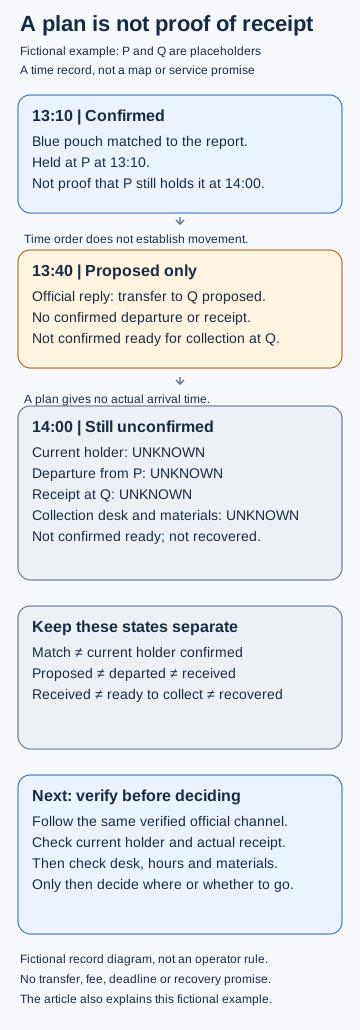
This is a separate invented example, not a real station, service record or transfer promise. At 13:10, a traveller uses a verified official channel to confirm that a blue soft pouch matches their report and is held at point P at that time. At 13:40, the same official follow-up channel replies that a transfer to Q is proposed. By 14:00, departure from P, receipt at Q, the collection desk and required materials remain unconfirmed. P and Q are placeholders; the example does not establish that this service exists.
| Private record | What the example supports | What still needs checking |
|---|---|---|
| Item match | Match confirmed at 13:10 | Keep identifying details out of public records |
| Last confirmed holding information | Held at P at 13:10 | Whether P still holds it at 14:00 |
| Transfer message | A proposed transfer to Q at 13:40 | Actual departure from P and actual receipt at Q |
| Collection arrangements | Collection not yet confirmed as possible; the traveller has not recovered the item | Actual desk, service window and required materials |
Do not record the item as “received at Q” or “collected”. A proposed transfer supplies no actual arrival time, and 13:40 is not a confirmed collection opening time at Q. Follow up through the original official channel to establish the current holder and receipt status before deciding where to go or whether to travel. Use itinerary planning for the confirmed parts of your personal time chain. Do not enter zero minutes for an unknown transfer or record expected recovery as an item already in your hands.
Add a private checklist: existing loss and item references ___ | verified channel and reply time ___ | last confirmed holder and time ___ | proposed receiving point ___ | departure confirmed or unconfirmed ___ | receipt confirmed or unconfirmed ___ | current holder and collection desk ___ | owner or proxy materials and service window ___ | conflicting replies and unknowns ___ | next official follow-up ___ | actual collection confirmation ___. Supply identifying information only through verified channels where it is required; do not publish ticket or identity numbers, phone numbers or all private features. Use the checklist to organise the next official follow-up; it does not guarantee a transfer, proxy collection, charge, deadline or recovery. The dated official sources above retain their stated consultation dates.
6. Copyable lost-property action card
- Actual operator identified as railway, metro, taxi or another service:
- Travel date and train or specific station:
- Last-seen time range:
- Carriage/seat area or station area:
- Public item category and colour:
- Private identifiers for the official channel only:
- Official search method, query time and result:
- Similar listing number and “unverified” status:
- No-match report time, record and next progress check:
- Holding point, desk, service window, documents, proxy, forwarding and charges:
- Every
UNKNOWNand its next action: - Privacy check: no ticket, identity number, code, phone or full identifiers published.
The decision branches, action card and fictional example are original HeTuZhi editorial methods. They promise no recovery, collection, forwarding, language support or processing time. Official pages were checked on 25 September 2026 and showed no publication date.