The useful question before ordering is not simply “What does this dish cost?” It is whether the dish name, size, pricing unit, quantity or billable weight, preparation charge and chosen extras produce a total you understand. This guide is limited to checking an order and bill. It does not give nutrition, allergy or medical advice, and confirming a charge is not a legal conclusion about it. Use the food map guide to choose an eating area, the budget travel guide for the wider trip, and the shared-cost ledger if diners later need to divide the actual bill.
1. Collect inputs that can form a total
Write six fields for every item: dish name, size or portion description, price, pricing unit, quantity or billable weight, and any separate charge. For an item priced per plate, person or bowl, record the number of plates, people or bowls. For a weight-priced dish, keep both parts of the rate—how much money per stated weight—and the weight that will actually be billed.
If ingredient and preparation charges are shown separately, both belong in the order total. Separate required charges from optional extras. A charge confirmed as required for this order belongs in the estimate at its confirmed amount, unit and quantity, even if you did not actively choose it. Tea, dipping sauces, tableware or other extras count according to your choice only when they are confirmed as optional. Including a charge in the budget does not establish that it is lawful; question an unacceptable requirement or pause before ordering. If whether it is required or optional, its amount, unit or quantity remains unclear, mark it as PENDING, never zero. Zero means the restaurant has explicitly confirmed that the charge does not apply to this order.
For a set menu, also check its included items, number of diners, substitutions and discount conditions. “A promotion is available” is not a number to subtract until eligibility and the actual reduction are established.
2. Read the quote back as one checkable statement
A Beijing market-regulator consumer notice published on 23 September 2026 discusses consistency between displayed ordering prices, clear pricing units, separately priced small portions, and bills showing items, unit prices and totals. A Quanzhou market-regulator page reproducing Fujian restaurant charging guidance, published on 14 February 2026, covers price units, separate ingredient and preparation charges, disclosure of extras, set contents and promotion restrictions. Both were checked on 25 September 2026. These are local notices and guidance, not proof that a particular restaurant has performed correctly or that a charge is lawful.
Use a short private read-back to the member of staff:
Please confirm: this dish is ___ yuan per ___, and this order will be billed as ___ portions or ___ grams. The preparation charge is ___ yuan per ___, and the extras I chose are ___. The current estimated order total is ___ yuan. Is any amount or unit still pending? If the weight, size or quantity changes, please tell me the revised calculation first.
Keep the clear reply with the menu, ordering screen or paper order record until payment. If the unit, weight basis or required charge cannot be established, choose a confirmed fixed-price small portion instead, or leave the unconfirmed dish unordered.
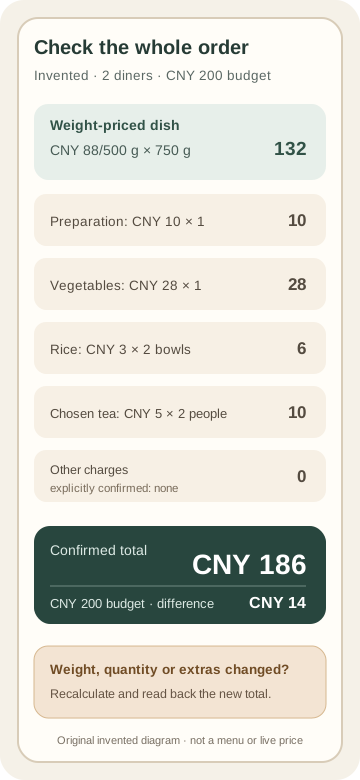
3. Work through a complete invented order
This is an invented CNY example, not a current restaurant price, and it says nothing about whether the portions are sufficient. Two diners have a CNY 200 budget:
- Weight-priced dish: CNY 88 per 500 g, with a 750 g billable weight, so
88 × 750 ÷ 500 = CNY 132. - Preparation charge confirmed for this example: CNY 10 per portion × 1 = CNY 10.
- Vegetable dish: CNY 28 per plate × 1 = CNY 28.
- Rice: CNY 3 per bowl × 2 = CNY 6.
- Tea actively selected: CNY 5 per person × 2 = CNY 10.
- Other charges: the restaurant has explicitly confirmed none for this order, so CNY 0. If nobody has answered the question, this field must remain pending instead.
The confirmed total is 132 + 10 + 28 + 6 + 10 = CNY 186, leaving CNY 14 against the CNY 200 budget. That CNY 14 is only the difference under the confirmed assumptions. It is not permission for another charge, a guarantee that the diners can absorb one, or evidence that the food will be enough.
4. Recalculate when weight, quantity or dishes change
If the billable weight becomes 900 g, the CNY 186 total is obsolete. The weighted dish becomes 88 × 900 ÷ 500 = CNY 158.40. The revised order is 158.40 + 10 + 28 + 6 + 10 = CNY 212.40, which is CNY 12.40 over budget. Read back the new weight, each charge and the new total before deciding whether to proceed. A confirmation based on 750 g cannot be carried over to 900 g.
Apply the same rule if a portion is added, a size is substituted, a dish is added or removed, or a preparation choice changes the amount. Update the affected line and sum again. If the new price, unit or charge remains unknown, pause rather than inserting an estimate. A fixed-price smaller option, removal of a chosen extra, or not ordering the unconfirmed dish can be a valid fallback; turning an unknown into zero is not.
5. Check once when dishes arrive and again at payment
When food arrives, compare task facts: dish name, size and number of portions, and whether anything was substituted or added. If something changed, compare it with the menu and order record and ask the restaurant whether the amount changes. Do not rely on reconstructing the order after leaving.
At payment, match every dish name, unit price, pricing unit, quantity or weight, preparation charge, selected extra and the whole-order total. Also check whether a cancelled or undelivered item remains on the bill. A correct sum does not resolve an unknown line; each unfamiliar item still needs an explanation.
For an apparent discrepancy, retain the menu that was visible, the order record and the bill, then ask the restaurant or original ordering platform about the specific line. Do not post personal information from a payment record publicly. This workflow does not promise a refund, price change or dispute outcome and does not calculate compensation.
6. Copy this order-checking card
- Diners and order budget: ___ people; CNY ___.
- Dish and size: ___; confirmed fixed-price small portion: ___ .
- Price and unit: CNY ___ per ___; quantity or billable weight: ___ .
- Ingredient amount: ___; preparation charge and unit: ___ .
- Chosen extras, each price, unit and quantity: ___ .
- Set contents, substitutions, promotion conditions and actual reduction: ___ .
- Every pending item: ___; charges explicitly confirmed as zero: ___ .
- Estimated total before ordering: ___; revised total after a change: ___ .
- Differences on delivery and the reply: ___; bill-check result: ___ .
- Stop condition: if the unit, billable weight, required charge or revised total cannot be confirmed, do not order that dish or switch to a confirmed fixed-price option.