This guide starts after the flight and accommodation have been chosen. It covers ground transport from the actual terminal's landside arrivals area to the accommodation door—not hotel selection, an airport transfer between flights, or catching another flight. Use the hotel-location guide to choose where to stay. If a traveller, luggage or mobility aid has specific access needs, verify each segment with the step-free route guide.
1. Define both ends and the travelling party
Do not write only the airport name. Record the terminal and the landside starting point shown by official airport directions. For the other end, record the property's full branch name, address and actual entrance. Two branches with “airport” in their names may be different places.
After reclaiming checked baggage, match the tag, bag count and visible exterior. Complete any remaining arrival procedures that apply, including customs where required, and use the actual time when you are landside as the starting point for the transport comparison. If damage is visible or missing contents are suspected, do not open the bag on your own beside the carousel or post baggage tags, identity documents or full reference numbers publicly. Ask the carrier, the ground handler for this flight or official airport staff where and how to report it; keep any reference, follow-up channel or other available evidence privately. If the on-site process cannot be completed, confirm the official follow-up route and current requirements, record the issue as pending and recalculate transport from the actual landside start. China Southern's domestic-arrivals flow uses Guangzhou Baiyun Airport as one example and advises matching the baggage tag and checking for damage. The page was checked on 26 September 2026. This article uses that single example only as a checking method and does not guarantee report acceptance, an outcome or compensation.
Record the full arrival date, scheduled landing time, number of travellers, number of bags, and any essential limits on walking, steps, transfers, waiting, child seating or mobility equipment. Scheduled landing is not the time a traveller can leave the arrivals hall. Disembarkation, immigration where applicable, baggage reclaim and customs vary. If their duration is unknown, record additional time pending—not zero or a universal margin. Confirm late-night reception separately; reaching the door does not establish that check-in is available.
2. Confirm that every link is actually available
For rail, airport bus, taxi or ride order, and a confirmed hotel pickup, check: the route from this terminal to the correct pickup point; direction of travel; whether the service will still be usable when the traveller reaches it; whether every transfer and final segment will operate; and whether the party, two bags, child seat or mobility aid meets operator conditions.
Do not read only the last departure from a route's starting point. Establish when it reaches the actual boarding point and whether the final segment remains usable after the transfer.
The Beijing Capital International Airport ground-transport page separates information by direction and terminal and says service frequency is subject to on-site and current official information. It was checked on 26 September 2026 Beijing time (25 September UTC). This supports checking terminal, direction and live status separately. No departure, door number or fare from that page is reproduced here, and it is not a rule for every airport.
Mark each option verified available, pending, or unavailable. Do not include pending or unavailable options in the ranking of confirmed plans. Keep at least one verified fallback; if everything is pending, obtain the missing facts before choosing the apparent fastest option.
If your chosen rail route involves changing metro lines, use the metro transfer guide to distinguish an in-station passage from a route through exit and entry gates. Check the next train's direction and the conditions for the fare medium you are using; include the walk and any re-entry steps in the door-to-door estimate.
3. Compare door-to-door time and whole-party cost
Use the same start—the same terminal's landside arrivals hall—and the same finish—the same accommodation entrance. Add non-overlapping segments: walk to pickup, wait, ride, transfer walk or queue, last vehicle, and the walk from drop-off to the door. Check whether an estimate already includes a segment before adding it again. Queue and road time can change, so the sum is not an arrival guarantee.
Compare the whole party, not a lowest per-person headline. Multiply per-person fares by travellers, then add confirmed whole-vehicle, reservation, baggage or other necessary items. List deposits and pending pre-authorisation separately. A dynamic quote or possible charge with no confirmed amount remains pending, never zero. Direct comparison is valid only when terminals, address, date and time, people, bags, essential conditions and charge scope match.
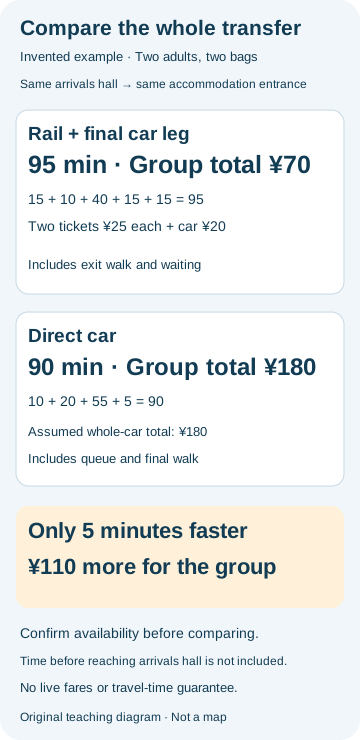
4. Invented example: five minutes versus CNY 110
Every number below is fictional, not a live fare, service or recommendation. Assume two adults with two suitcases. Both options have been verified as available at that time and able to carry the travellers and bags. Both run from the same terminal's landside arrivals hall to the same accommodation door.
Rail plus a last vehicle
- 15-minute walk + 10-minute wait + 40 minutes aboard rail + 15 minutes to exit, walk to and wait at the last-vehicle pickup point + a 15-minute last ride directly to the same accommodation door = 95 minutes.
- Two CNY 25 tickets + one CNY 20 whole-vehicle fare = CNY 70 for the party.
Direct vehicle
- 10-minute walk + 20-minute queue + 55-minute ride + 5-minute walk to the door = 90 minutes.
- The fictional whole-vehicle quote is CNY 180 and has been confirmed to include every payable item in this example: CNY 180 for the party.
The direct vehicle saves only five minutes here and costs CNY 110 more. That does not make either option universally best. Travellers may weigh fewer transfers against lower cost differently. Neither calculation includes disembarkation, immigration, baggage reclaim or customs before reaching landside arrivals. That additional time remains unknown and must be added, not replaced with zero. No universal buffer or transport guarantee is implied.
5. Recheck at pickup and after delays
Follow airport signs to an authorised pickup area, then recheck direction, destination, current status and charge scope. For an ordered vehicle, match the vehicle and plate to the order. If they differ, do not board; remain in a safe public area and ask airport staff, the operator or the original platform for help. Do not enter restricted areas, cross vehicle lanes or accept an unverifiable solicitation to reduce cost.
After a delay to arrival, baggage reclaim or the queue, check whether the entire journey still works at the current time. Do not simply shift every old time later. If rail or the final connection has stopped running, the pickup waiting window has expired or quote conditions have changed, mark the old option unavailable or pending and use a verified fallback. If none remains, contact the property and an official airport service channel rather than rushing unsafely to protect the original budget.
Ask the actual operator about child seats, wheelchairs or other mobility aids, reservations and boarding conditions. This guide does not teach lifting or transfer techniques and does not assume an ordinary vehicle is suitable.
If an entire checked bag is still absent from the correct carousel and any alternative point confirmed by staff, use the delayed checked-baggage guide to open a record with the flight's carrier or ground handler before recalculating the landside start time. “Tracing”, “located”, carrier or delivery-provider acceptance, and “in transit” do not mean that the traveller or an authorised collector has received the bag.
6. Copyable airport-to-door comparison card
- Date, scheduled landing time and actual terminal: ___
- Expected landside-ready time / pending disembarkation, immigration, baggage and customs time: ___ / ___
- Property name, address and entrance / late reception separately confirmed: ___ / ___
- Travellers, bags, walking, steps, child-seat or mobility-equipment needs: ___
- Option A—pickup point, direction, transfers, final segment and availability: ___
- Option A—segment minutes, door-to-door total, whole-party cost and pending charge: ___
- Option B—same fields: ___
- Verified fallback and switch trigger: ___
- Pickup recheck time; vehicle/plate/order match; help channel: ___
For the return journey from accommodation to the airport, use the airport departure checklist to verify check-in, checked-bag acceptance, security, reporting to the correct gate and boarding acceptance separately, then work back from every confirmed hard deadline. Successful online check-in does not complete the later stages.
Keep the card privately in an offline travel kit, while remembering that an offline copy does not refresh services, queues, quotes or traffic. This method does not guarantee availability, punctuality, baggage capacity or price; recalculate when real conditions change.